Home & Garden Landscapes

Creating beautiful landscapes in North Carolina and Virginia since 2002

Raleigh • Durham • Chapel Hill

Creative Landscaping Solutions
for Fine Properties Since 2002

Call 919-801-0211

  • Home
  • Services
    • Landscaping Installation Services
    • Hardscapes
    • Design Services
  • Portfolio
    • Residential Design & Installation
      • Curb Appeal
      • Backyard Retreat
      • Estates & Country Retreats
      • Screening & Privacy Solutions
      • Swimming Pool Retreats
      • Cold Hardy Palm Oasis
      • Lake & Waterfront Landscapes
    • Commercial & Institutional
    • Historic Landscape Restorations
  • Plant Catalog
    • Shade Trees
    • Ornamental & Flowering Trees
      • Crape Myrtles
      • Southern Magnolias
      • Camellias
      • Dogwoods
    • Holly
    • Coniferous Evergreens
      • Green Giants
      • Cryptomeria
      • Cedars
      • Spruce
      • Emerald Green Arborvitae
      • Eastern White Pine
    • Japanese Maples
    • Cold Hardy Palms
    • Mature Bamboo
  • FAQ
  • Ask Sprout!
  • Extras
    • Resources
      • Plant Care Guides
      • Hardiness Zones
      • Fire Ant Quarantine Map
    • Big Tree Installation
    • American Elm Project
    • Our Cold-Hardy Palms
    • Videos
  • Our Team
  • Blog
  • Contact Us

Crape Myrtle Scale: What It Is, What It Does, and How to Save Your Trees

June 10, 2026 By admin

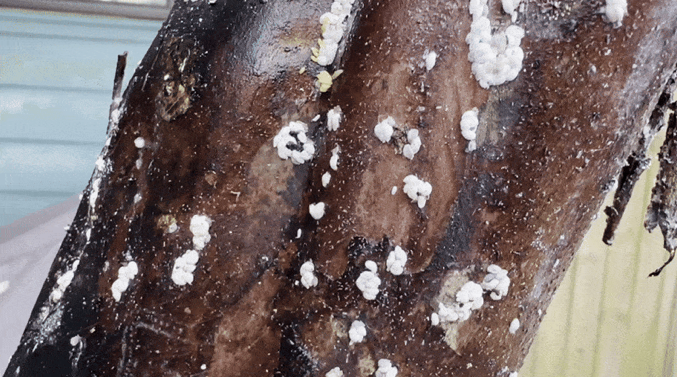
If your crape myrtles have developed a white or gray crusty coating on the bark — and if black sooty mold has followed — you are looking at crape myrtle bark scale (CMBS), the most significant new pest threat to one of the Triangle’s most beloved ornamental trees. CMBS has been spreading steadily across North Carolina since it was first confirmed in the state, and it is now well-established in the Raleigh, Durham, Chapel Hill, and Cary areas.

The good news: crape myrtle bark scale is treatable. Trees that are correctly identified and treated on the right timeline can fully recover. The bad news: many homeowners misdiagnose the problem, apply the wrong treatment, or delay too long — allowing the infestation to reach a severity that is much harder to reverse.

This guide covers everything Triangle-area homeowners need to know: what crape myrtle bark scale is, how to identify it, what it does to your trees over time, and how to treat and manage it effectively in Zone 7b conditions.

What Is Crape Myrtle Bark Scale?

Crape myrtle bark scale (Acanthococcus lagerstroemiae, formerly Eriococcus lagerstroemiae) is a felt scale insect native to Asia. It was first detected in the United States in Texas in 2004 and has since spread across much of the Southeast. In North Carolina, CMBS has been confirmed in most Piedmont counties and is continuing to expand its range.

Unlike many pest insects that attack weakened or stressed plants, crape myrtle bark scale can and does infest healthy, well-established crape myrtles. It is not a sign that your trees were planted incorrectly or are otherwise compromised — it is an opportunistic invasive pest that specifically targets Lagerstroemia species and a small number of closely related plants.

The scale feeds by inserting a stylet (a needle-like mouthpart) into the phloem tissue of the bark and extracting plant sap. This feeding depletes the tree’s resources and, at high infestation levels, can noticeably reduce flowering, weaken branch structure, and stress the tree in ways that make it more susceptible to secondary problems.

How to Identify Crape Myrtle Bark Scale

CMBS is one of the easier landscape pests to identify once you know what you are looking for. The challenge is that many homeowners notice the sooty mold — which is secondary and highly visible — before they notice the scale itself.

The Primary Symptom: White or Gray Felt-Like Crust on Bark

Crape myrtle bark scale colonies appear as white to pale gray felt-like or waxy encrustations on the bark. They colonize most heavily at branch crotches, on smaller stems, and at pruning wounds, but at high infestation levels they can cover large sections of the main trunk and major scaffold branches.

When you press or crush an active scale colony with your finger, you will see pink or reddish fluid — this is the characteristic field test that distinguishes CMBS from other bark discolorations. No other common crape myrtle problem produces this pink crush test result.

The Secondary Symptom: Black Sooty Mold

Like many sap-feeding insects, CMBS excretes honeydew — a sticky, sugar-rich waste product — as it feeds. This honeydew coats bark, branches, and often the leaves and any surfaces below the tree, and it serves as a growth medium for sooty mold fungi. The result is the black or dark gray coating that often alerts homeowners to a problem before they locate the scale itself.

Sooty mold does not directly harm the tree tissue it grows on, but in severe cases it can reduce photosynthesis in foliage. More practically, it makes affected trees look seriously unhealthy and can blacken pavement, furniture, and other surfaces beneath the canopy.

What CMBS Is Not

Several common crape myrtle conditions are mistaken for scale:

  • Powdery mildew — a fungal disease that produces a white powdery coating on leaves and young shoots, not on bark. Powdery mildew is encouraged by low air circulation and moderate temperatures; it does not produce the pink crush test.
  • Lichen — crusty gray-green or silvery patches on bark that are a symbiotic relationship of algae and fungi. Lichen does not produce pink fluid when crushed and is not harmful to the tree.
  • Normal bark coloration and exfoliation — crape myrtle bark naturally exfoliates in attractive patches of tan, cinnamon, and gray. This peeling bark is a feature of the tree, not a symptom of disease or pest damage.

If in doubt, the pink crush test is your field diagnostic. CMBS is the only common crape myrtle pest that produces it.

Crape Myrtle Bark Scale: Quick Identification Reference

Symptom

CMBS

Likely Alternative

White coating on bark

Felt-like, waxy crust; pink when crushed

Lichen (no pink fluid); powdery mildew (on foliage only)

Black coating

Sooty mold on honeydew from scale feeding

May also follow aphid infestation

Location on tree

Branch crotches, stems, trunk; pruning wounds

Powdery mildew: foliage and new growth only

Pink crush test

Yes — diagnostic for CMBS

No other common crape myrtle condition produces this

Reduced flowering

Yes, at moderate to high infestation levels

Powdery mildew: can also reduce flowering


What Crape Myrtle Bark Scale Does to Your Trees

A light CMBS infestation on an otherwise healthy, established crape myrtle may be nearly invisible and cause minimal impact. But the pest reproduces rapidly, overwinters on the bark, and builds population pressure year over year if left untreated. Understanding the progression helps explain why early treatment produces dramatically better outcomes than waiting.

Year 1–2: Early Infestation

Early colonies are small and concentrated in branch crotches and at pruning sites. Flowering is generally not yet affected, and the tree’s overall vigor remains normal. At this stage, treatment is highly effective and recovery is fast. Many homeowners miss this window entirely because the symptoms are subtle — a bit of white crust in branch angles that is easily overlooked.

Year 2–4: Moderate Infestation

As the population expands, colonies spread to larger stem sections and the main scaffold branches. Honeydew production increases, and sooty mold becomes conspicuous — often this is when homeowners first realize something is wrong. Flowering is noticeably reduced, and the aesthetic impact of sooty mold becomes significant. Treatment at this stage is still very effective but requires more thorough application and may take a full growing season to show full results.

Year 4+: Heavy Infestation

At heavy infestation levels, the entire canopy framework may be encrusted, sooty mold is pervasive, and the tree’s energy resources are being substantially depleted. Flowering can be severely reduced or essentially absent. Trees at this stage are also more susceptible to drought stress and secondary pathogens. Treatment remains possible and worthwhile for established specimen trees, but recovery takes longer and requires consistent follow-up.

The key takeaway: crape myrtle bark scale is a progressive problem. A tree with a light infestation today will have a moderate to heavy infestation in two to three years without treatment. Early identification and prompt treatment produce the best outcomes and the lowest treatment cost over time.


How to Treat Crape Myrtle Bark Scale

Effective CMBS management typically involves a combination of physical removal, systemic insecticide treatment, and monitoring. No single application eliminates the pest permanently — ongoing attention, particularly in the early spring before egg hatch, is part of a realistic management program.

Physical Removal: Scrubbing

For accessible bark on smaller trees or lower trunk sections, physical scrubbing with a soft brush and diluted dish soap solution can remove scale colonies directly. This is most effective as a supplemental step rather than a standalone treatment. Scrubbing reduces the scale load on the bark and removes some of the sooty mold, but it does not reach scale populations in branch crotches and upper canopy without significant effort.

For specimen-grade trees or those in prominent landscape locations, scrubbing the accessible portions of the trunk in late winter — before the growing season begins — can meaningfully reduce the starting population ahead of systemic treatment.

Systemic Insecticide: Soil Drench or Trunk Injection

The most effective treatment for established CMBS infestations is a systemic imidacloprid application — either as a soil drench around the root zone or as a trunk injection. Imidacloprid is taken up through the roots (or trunk, in the case of injection) and distributed throughout the tree’s vascular system, where it is ingested by the scale insects as they feed.

Timing matters: applications in late April through May — as the tree is actively growing and before the first generation of crawlers (the mobile, newly hatched juvenile scale) is in full activity — produce the strongest uptake and the most effective control. Soil drench applications should be made to moist soil for optimal absorption.

Important: Imidacloprid is a systemic insecticide with known effects on pollinators, including bees, that visit flowers. Crape myrtles are pollinator-visited plants. Applications timed to late spring — before bloom — minimize exposure risk, but this is a consideration that professional applicators factor into treatment planning.

Horticultural Oil: Overwintering Population Suppression

A dormant-season application of horticultural oil (applied in late winter before bud break) can smother overwintering scale and reduce the starting population for the growing season. This is most useful as part of a multi-year management program rather than a one-time intervention. Horticultural oil must achieve good coverage of bark surfaces to be effective — large or heavily infested trees are difficult to treat this way without professional equipment.

What Does Not Work

Several common interventions are either ineffective against CMBS or counterproductive:

  • Contact insecticide sprays applied to bark — scale insects are protected by their waxy covering; contact sprays that do not reach the crawler stage at the right window have minimal effect on established colonies.
  • “Crape murder” (severe topping) as a response to scale — hard pruning creates large fresh wounds that actually provide ideal colonization sites for new scale populations and compounds the tree’s stress.
  • Treating sooty mold directly — sooty mold is a symptom, not the cause. It will resolve as scale populations are controlled and honeydew production decreases; treating the mold without treating the scale provides only cosmetic and temporary improvement.

Crape Myrtle Scale in the NC Triangle: What to Expect

CMBS is present and spreading in Wake, Durham, Orange, and Chatham counties. If you have established crape myrtles and have not examined the bark recently, a close inspection in late winter or early spring — when scale colonies are visible and dormant oil treatment is timed — is a worthwhile annual practice.

The pest spreads primarily through movement of infested plant material, but it also spreads short distances by crawler movement and on the bodies of birds and other animals that contact infested bark. Once CMBS is established in a neighborhood, nearby trees are at meaningful risk. Treating an infested tree promptly reduces the population available to spread to adjacent plants.

Zone 7b temperatures do not reliably suppress CMBS. The pest overwinters successfully in our climate and resumes activity reliably in spring. Management is an ongoing process, not a one-time intervention.

Do Some Crape Myrtle Cultivars Resist Scale Better Than Others?

Research on CMBS cultivar susceptibility is still developing, but preliminary data and field observations suggest that while no Lagerstroemia cultivar is immune, some show meaningful differences in susceptibility. The following reflects current understanding — not definitive resistance ratings.

Cultivar

Relative Susceptibility

Notes

Natchez

Lower

One of the more frequently cited cultivars with lower observed infestation rates; excellent specimen tree

Muskogee

Lower to moderate

Lavender-flowering large-form cultivar; widely planted in Triangle

Tuscarora

Moderate

Coral-pink; popular in residential landscapes

Dynamite

Moderate to higher

Red-flowering; widely planted; monitor closely

Acoma

Lower

Compact weeping white; frequently performs well

Tonto

Moderate

Compact fuchsia-red; inspect branch crotches carefully

Note: cultivar susceptibility data should be treated as a general guide, not a guarantee. Environmental conditions, tree health, and local pressure all influence infestation outcomes. Annual inspection remains important regardless of cultivar.


When to Call a Professional

Crape myrtle bark scale management is well within the capabilities of attentive homeowners for trees in the early stages of infestation. But several situations warrant professional assessment and treatment:

  • Large specimen trees with heavy infestations — effective systemic treatment of a 20-to-25-foot multi-trunk specimen requires proper equipment and application rates that are difficult for homeowners to achieve with off-the-shelf products.
  • Multiple trees affected across a property — coordinated treatment timing and application produce better results than piecemeal homeowner applications.
  • Trees with compound problems — scale plus secondary stress (drought, root damage, compaction) requires a management approach that addresses the full picture, not just the pest.
  • Uncertainty about diagnosis — before treating, confirm you are dealing with CMBS. Misdiagnosis wastes money and delays effective intervention. A professional can confirm scale, assess infestation severity, and recommend a treatment sequence appropriate to the specific tree and situation.

Home & Garden Landscapes works with licensed applicators for pest management treatments and can assess your crape myrtles as part of a landscape consultation. We also provide professional pruning, corrective work, and soil remediation for trees recovering from scale damage.

The specimen tree standard: an established, well-positioned crape myrtle represents a meaningful landscape investment. A Natchez or Muskogee specimen at 15 to 20 feet, correctly installed, contributes structure, seasonal color, and character that takes years to build. Treating CMBS promptly protects that investment. Replacing a mature specimen — if it cannot be saved — costs far more than treatment.


Concerned About Your Crape Myrtles? Let’s Take a Look.

Home & Garden Landscapes has been serving the Raleigh, Durham, Chapel Hill, Cary, Apex, Wake Forest, and greater Triangle region since 2002. We know the plants and the pest pressures of NC Zone 7b — including crape myrtle bark scale, which we are seeing with increasing frequency on established residential specimens across the Triangle.

If you have noticed white crust, sooty mold, or reduced flowering on your crape myrtles — or if you simply want your crape myrtles inspected as a preventive measure — call us for a free consultation.

Call 919-801-0211 to schedule your free consultation.
NC Licensed Landscape Contractor · NCLC #2591 · homeandgardenlandscapes.com


Filed Under: Uncategorized

How to Help Your Garden Survive a Drought

May 21, 2026 By admin

North Carolina summers have always tested a landscape. But drought in the Triangle is becoming a more frequent and more severe challenge — not just a hot week in August, but extended stretches of 90-plus-degree days with no meaningful rainfall, low humidity at night, and soil moisture deficits that accumulate across weeks. The plants and landscapes that look great in April can be under serious stress by July.

The good news is that with the right preparation, the right plants, and the right practices, your garden can not only survive a drought but come through it with minimal loss. This guide covers everything Triangle-area homeowners need to know — from emergency triage during an active drought to the long-term decisions that determine how drought-resilient your landscape will be for years to come.

Understanding Drought Stress in NC Piedmont Gardens

Zone 7b landscapes in the North Carolina Piedmont face a specific combination of stressors that makes drought management different here than in other parts of the country. The region’s clay-heavy soils hold moisture better than sandy coastal plain soils, but they also compact easily, which prevents water from penetrating to root depth when it does rain. Mature trees may have roots well below the water table, but newly planted shrubs and perennials are entirely dependent on topsoil moisture.

Beyond soil type, the thermal load in a Piedmont summer is significant. Temperatures routinely exceed 95°F for days at a stretch, and radiant heat from driveways, patios, and walls can push temperatures in planting beds 10 to 15 degrees higher than ambient air. Plants lose moisture through their leaves at a rate that far exceeds what shallow-rooted plants can draw from dry soil — a condition called transpiration stress.

Understanding this context is important because it changes which interventions actually matter. Watering at the wrong time, in the wrong amount, or in the wrong location can waste water without meaningfully helping your plants. Getting the fundamentals right — mulch depth, watering method, soil health — has far more impact than any product or supplement.

Priority One: Mulch Is Your Most Powerful Drought Tool

If you do nothing else to prepare your landscape for drought, mulch deeply. A 3- to 4-inch layer of organic mulch — shredded hardwood, pine bark, or pine straw — is the single most effective tool available for reducing soil moisture loss in a planting bed. Mulch reduces soil temperature, slows evaporation, prevents the soil surface from crusting and shedding water rather than absorbing it, and improves soil biology over time.

The math is significant. An unmulched bed in full sun in July can lose a quarter-inch of soil moisture per day to evaporation. A properly mulched bed may lose a fraction of that. Over a two-week dry stretch, that difference determines whether the plants in that bed survive or fail.

Mulch Best Practices for NC Summers

  • Apply mulch by mid-May, before sustained heat arrives — mulching in July when beds are already dry is less effective
  • Maintain a consistent 3–4 inch depth; thinner applications don’t provide adequate insulation
  • Keep mulch 2–3 inches away from plant stems and tree trunks to prevent crown rot
  • Refresh mulch annually — it breaks down into the soil over time, which is beneficial, but the insulating depth needs to be maintained
  • Shredded hardwood and pine bark stay in place better on slopes than pine straw, which can migrate in heavy rain


How to Water Correctly During a Drought

Watering during a drought is not simply a matter of adding more water — it is a matter of delivering water in the right amount, at the right depth, at the right time, and in the right location. Inefficient watering wastes water while leaving your plants undirected and stress-prone.

Water Deeply and Infrequently

The instinct to water more often during a drought is understandable but usually counterproductive. Frequent, shallow watering trains plants to keep their root systems near the soil surface, where moisture fluctuates most dramatically. Deep, infrequent watering — delivering enough water to penetrate 8 to 12 inches into the soil — encourages roots to follow moisture downward into more stable soil layers.

For established shrubs and trees, this typically means one deep watering per week in the absence of meaningful rainfall. For newly planted material in its first or second year, more frequent attention is required — every 3 to 4 days during prolonged heat and drought.

Water at the Drip Line, Not the Trunk

A common mistake is concentrating irrigation at the base of a plant — at the trunk or main stem. The roots responsible for water uptake — the fine, absorptive root hairs — are located at the outer edge of the root zone, which roughly corresponds to the drip line of the plant’s canopy. Watering at the drip line delivers water where the plant can actually use it.

Time Your Watering for Minimum Loss

Early morning watering — ideally between 5 and 9 a.m. — minimizes evaporative loss and allows foliage to dry before evening, reducing the risk of fungal disease. Midday watering is largely ineffective in summer: solar radiation and low humidity cause significant evaporation before water can penetrate the soil. Late evening watering works for root-zone delivery but leaves foliage wet overnight.

Drip Irrigation Is Worth the Investment

If you are installing new beds or overhauling existing ones, drip irrigation is one of the most consequential infrastructure investments you can make for drought resilience. Drip systems deliver water directly to the root zone at a rate the soil can absorb, eliminating runoff and reducing water use by 50 to 70 percent compared to overhead sprinklers. For specimen plants and foundation plantings, soaker hoses are a lower-cost alternative that provides many of the same benefits.

Triage: What to Do When Drought Has Already Set In

If your garden is already showing signs of drought stress — wilting, leaf scorch, premature leaf drop, browning tips — triage requires prioritizing which plants to protect and accepting that some may not be worth saving.

Triage Priority Hierarchy

Priority 1 — Mature trees and large specimen plants. The replacement cost for a well-established tree is enormous, and the ecological and aesthetic value is irreplaceable. Irrigate deeply at the drip line. A mature tree may need 15 to 20 gallons per inch of trunk diameter per week during sustained drought.

Priority 2 — Newly installed plantings (first two years). Plants in their first or second year have limited root systems and are far more vulnerable than established plants. They require active intervention during drought regardless of species.

Priority 3 — Foundation and entry plantings. High-visibility plantings that contribute directly to property value and curb appeal warrant more intensive care during drought.

Priority 4 — Perennials and annuals. Most perennials will come back from drought dormancy. Many annuals will not, but their replacement cost is low. Let them go if water needs to be directed elsewhere.

Priority 5 — Turf. Lawn grass is highly drought-tolerant when given the chance to go dormant. A brown lawn in August is not a dead lawn. Allow it to go dormant rather than using significant water to keep it green.


Drought-Smart Plant Selection: Building Long-Term Resilience

The most drought-resilient landscapes are built on plant selection, not irrigation. The right plant in the right place — adapted to NC Piedmont conditions, appropriate for the site’s sun exposure and soil type, and not reliant on supplemental water once established — will outperform any landscape that depends on irrigation to survive.

Best Drought-Tolerant Trees for NC Zone 7b

  • Native oaks (Quercus alba, Q. rubra, Q. phellos) — deep-rooted, exceptionally drought-tolerant once established, provide irreplaceable canopy
  • Willow oak (Quercus phellos) — particularly well-adapted to Piedmont clay, fine-textured foliage, handsome fall color
  • Bald cypress (Taxodium distichum) — often associated with wet sites but performs well in average to dry soils once mature
  • Southern sugar maple (Acer barbatum) — more drought-tolerant than its northern relatives, excellent fall color in the Piedmont
  • Eastern red cedar (Juniperus virginiana) — extremely tough, native evergreen; not a focal point specimen but excellent for screening and naturalizing


Best Drought-Tolerant Shrubs for NC Zone 7b

  • Oakleaf hydrangea (Hydrangea quercifolia) — native, tolerates drought once established, exceptional multi-season interest
  • Beautyberry (Callicarpa americana) — native, nearly indestructible once established, remarkable purple fruit in fall
  • Yaupon holly (Ilex vomitoria) — the most adaptable native evergreen shrub in the Southeast; drought, salt, poor soil — it survives all of it
  • Virginia sweetspire (Itea virginica) — native, reliable, excellent fall color, tolerates drought and wet conditions equally
  • Possumhaw (Ilex decidua) — stunning red winter berries, native, tolerates drought and clay


Grasses and Groundcovers

  • Zoysia grass — far superior to tall fescue in drought; goes dormant gracefully and recovers quickly after rain
  • Native fescues (Festuca species) — fine-textured, drought-tolerant in partly shaded sites
  • Liriope (Liriope muscari) — evergreen groundcover, nearly maintenance-free once established, survives full drought dormancy
  • Pennsylvania sedge (Carex pensylvanica) — low-growing native groundcover for shaded dry sites


Quick Reference: Drought Survival Strategies


Plant / Material

Drought Role

Best For

NC Zone 7b Notes

3–4″ Organic Mulch

Retains soil moisture, insulates roots

All plantings

Apply May before heat sets in

Deep watering (weekly)

Encourages deep root development

Established shrubs & trees

1″ per week at drip line

Native oaks & hickories

Deep-rooted, drought-adapted once established

Shade canopy, long-term

2–3 yr establishment period

Drought-tolerant grasses

Low supplemental water needs

Turf areas, slopes

Fescue struggles; Zoysia excels

Drip irrigation

Delivers water directly to root zone

Beds, new plantings

50–70% more efficient than overhead


Soil Health: The Foundation of Drought Resilience

Healthy soil is drought-resilient soil. Soils rich in organic matter hold moisture more effectively, drain better when rainfall comes, and support the soil biology that helps plant roots access water and nutrients efficiently. The NC Piedmont’s native clay soils can be improved dramatically over time through consistent organic matter addition — and that investment pays dividends during every drought that follows.

If you haven’t had your soil tested recently, the North Carolina Department of Agriculture offers low-cost soil testing through NC State Extension. A basic test will tell you your soil’s pH, macronutrient levels, and organic matter content — all of which influence how your plants handle moisture stress. Most Piedmont soils benefit from periodic lime applications to bring pH into the 6.0–6.5 range where nutrients are most available.

Soil Amendments Worth Considering

  • Compost — the single most universally beneficial amendment; improves both water retention in sandy soils and drainage in clay soils
  • Expanded shale or coarse grit — improves drainage and aeration in compacted clay planting beds
  • Biochar — increasingly supported by research as a soil amendment that improves water retention and microbial activity; apply at 10–15% of bed volume


What Not to Do During a Drought

Some common responses to drought stress can make the situation significantly worse. Avoid the following:

  • Fertilizing drought-stressed plants — pushing new growth during water stress causes plants to demand more moisture than roots can supply; hold off on fertilizer until drought breaks
  • Heavy pruning during drought — removing foliage reduces the plant’s ability to manufacture the carbohydrates it needs to sustain itself; emergency structural pruning is fine, but routine shaping should wait
  • Overhead watering at midday — high evaporation rates mean most of the water never reaches roots
  • Planting new material during peak drought — if you must plant in summer, select drought-tolerant species, plant late in the day, and water every other day for the first month
  • Ignoring new plantings — established plants often survive drought with minimal intervention; plants in their first year often don’t


When to Call a Landscape Professional

Most drought management can be handled by an attentive homeowner with good information. But certain situations benefit from professional involvement — and addressing them before severe drought arrives is significantly easier and less costly than after.

If your property has high-value specimen trees that have shown any signs of decline, having an arborist assess root zone health and soil conditions before drought season is worthwhile. If you’re considering replacing lawn areas with more drought-tolerant plantings, a landscape designer can develop a plan that balances aesthetics and resilience. And if you’re planning new installations — privacy screens, foundation plantings, specimen trees — a licensed contractor can ensure that plant selection, spacing, and irrigation infrastructure are appropriate for long-term drought tolerance.

Home & Garden Landscapes has been serving the Triangle region since 2002. We specialize in plant selection and installation for NC Piedmont conditions — including specimen-grade trees, privacy screening, and landscape renovation — and we understand the specific challenges that Zone 7b summers present. Whether you’re preparing a new property for drought resilience or recovering from a season of heat and stress, we can help.


Ready to build a more drought-resilient landscape? Call Home & Garden Landscapes at 919-801-0211 or visit homeandgardenlandscapes.com to schedule a consultation.


Filed Under: Uncategorized

Instant Privacy Screening for New Construction: How to Get Privacy Without Waiting Years

April 22, 2026 By admin

Moving into a newly built home in the Triangle region comes with a long list of things to love — and one problem that almost no one anticipates until they’re living it: you have no privacy. New construction lots are cleared, graded, and exposed. Neighbors are close. Roads and adjacent properties are visible from nearly every angle. The backyard you imagined as a retreat is, for now, completely open.

The conventional landscaping approach — plant small, wait years — is not an answer to that problem. A 3-gallon holly or a 4-foot arborvitae installed today will take five to eight years to reach meaningful screening height in North Ca`rolina’s Piedmont climate. For most homeowners, that is simply not acceptable.

There is a better approach. Mature, specimen-grade privacy trees installed at 8 to 15 feet in height create a finished, functioning privacy screen on the day of installation. This guide explains how that process works, which plants perform best for new construction screening in the Raleigh, Durham, and Chapel Hill area, and what to expect from the installation.

Why New Construction Lots Are Especially Challenging

New construction landscapes present a set of conditions that make privacy screening harder than on established properties — and that make plant selection and sizing more important, not less.

Cleared and Compacted Soil

Construction activity strips topsoil, compacts subsoil, and leaves behind a root environment that is far less hospitable than an established yard. Heavy equipment passes, concrete washout, and grading operations all degrade the soil structure that trees depend on for establishment. Before any privacy screening goes in, soil conditions need to be assessed and amended — a step that general landscapers frequently skip and that can mean the difference between a privacy screen that establishes quickly and one that struggles for years.

No Existing Vegetation to Buffer

On an established property, even a partially failing hedge provides some visual separation while a replacement is going in. On a new construction lot, there is nothing. The exposure is total, and it typically begins the moment the homeowner moves in. This is why the size of replacement plants matters so much: when there is no interim buffer, the installation itself needs to function as a finished screen from day one.

Tight Lot Lines and HOA Considerations

New construction communities in the Triangle region — particularly in fast-growing suburbs like Apex, Wake Forest, Cary, and Holly Springs — often have tight lot lines, utility easements, and HOA guidelines that constrain where and what you can plant. A professional consultation before purchasing plant material is essential to ensure that the screening plan is compliant and optimally placed given the site constraints.

The Case for Mature Specimen-Grade Plants

The defining characteristic of a mature specimen-grade plant is size at installation. Where a nursery-grade plant arrives in a container and stands 3 to 5 feet tall, a specimen-grade plant is field-grown and installed at 8, 10, 12, or even 15 feet in height — depending on species and availability.

The practical difference is not subtle. A row of 10-foot Emily Bruner hollies installed along a property line provides immediate, dense, year-round screening. That same row planted from 3-gallon containers would take the better part of a decade to reach the same effect in Zone 7b’s growing conditions.

The key insight:

Specimen-grade plants cost more per unit than nursery-grade plants — but the cost of waiting five to eight years for privacy, measured in lost enjoyment of your outdoor space, is rarely factored into that comparison.

At Home & Garden Landscapes, every privacy screen we install uses specimen-grade plnt material specifically because our clients cannot afford to wait. When the installation crew leaves your property, the screen is complete.


Best Plants for Instant Privacy Screening on New Construction Lots

The right plant for your new construction lot depends on your specific conditions — sun exposure, lot size, soil, deer pressure, and HOA restrictions. Below are the top-performing options we install across the Triangle region, matched to common new construction scenarios.

Situation

Best Plant Choice

Installed Height

Sun / Shade

Full sun, open boundary

Nellie Stevens Holly

8–15 ft

Full sun

Shaded or wooded line

Emily Bruner Holly

8–15 ft

Full sun to full shade

Max height, fast coverage

Green Giant Arborvitae

10–15 ft

Full sun to part shade

Aesthetic / visible hedge

Cryptomeria japonica

8–12 ft

Full sun to part shade

Large-scale or estate screen

Southern Magnolia

12–20 ft

Full sun to part shade

Emily Bruner Holly — Best for Shaded Boundaries

Emily Bruner Holly (Ilex × ‘Emily Bruner’) is our most-recommended privacy screening plant for new construction lots in the Triangle region, particularly where shade is a factor. It performs reliably from full sun to full shade — a range no conifer can match — and reaches 20 to 25 feet at maturity with a dense, pyramidal form that provides solid year-round coverage. Hardy in Zones 6 through 9, deer resistant, and completely free of the disease vulnerabilities that plague Leyland cypress, Emily Bruner Holly is the workhorse of new construction privacy screening in NC.

Nellie Stevens Holly — Best for Sunny Exposures

Nellie Stevens Holly (Ilex × ‘Nellie R. Stevens’) is the preferred choice for south- and west-facing property lines where maximum sun is available. It establishes quickly, produces dense glossy foliage year-round, and reaches 15 to 25 feet at maturity. Like Emily Bruner, it is deer resistant and disease resistant — two qualities that matter enormously in newly developed suburban communities where deer pressure is high and the soil environment is stressed.

Green Giant Arborvitae — Best for Maximum Height

For new construction lots on large parcels, or situations where the screening need calls for eventual heights of 30 feet or more, Green Giant Arborvitae (Thuja plicata ‘Green Giant’) is the most effective option. Growth rates of 3 to 5 feet per year mean that even nursery-grade plants close the gap relatively quickly — but installed as specimens at 10 to 15 feet, they provide immediate impact and an accelerated path to mature coverage.

Cryptomeria — Best for Aesthetic Screening

When the privacy hedge is visible from the main living areas of the home and needs to contribute positively to the landscape’s overall design, Cryptomeria japonica is the refined choice. Its soft, feathery texture and gracefully irregular form bring genuine visual character to a screening planting — important in new construction communities where the landscape will be seen every day and where curb appeal matters.

What the Installation Process Looks Like

Homeowners who have only experienced conventional landscaping are often surprised by the scope of a mature specimen installation. Moving and establishing large plants requires different equipment, different techniques, and considerably more horticultural knowledge than a standard nursery planting. Here is what the process typically involves:

  • Site assessment and consultation — we visit the property to evaluate soil conditions, sun and shade patterns, lot line locations, utility easements, and HOA restrictions before any plant material is selected
  • Soil preparation — compacted construction soil is amended before planting to ensure root establishment; this step is frequently skipped by general landscapers and is one of the most important predictors of long-term plant health
  • Plant sourcing — specimen-grade material at the heights required for immediate screening is sourced from our specialty grower network; availability varies by species and season
  • Installation — mature specimens require proper equipment for delivery and placement; our crews handle the full process from site preparation through final positioning and establishment watering
  • Aftercare guidance — newly installed specimen-grade plants require consistent moisture through their first growing season; we provide specific care instructions for every installation

For most residential new construction privacy screen installations in the Triangle region, the full process from initial consultation to completed installation takes two to four weeks.

How Much Does Instant Privacy Screening Cost?

The honest answer is that cost varies significantly based on the length of the screen, the species selected, the sizes required, and site conditions. Specimen-grade plants are priced differently from nursery-grade plants, and installations that require significant soil preparation or equipment access add to the overall scope.

What we can say with confidence is that the cost of a properly installed specimen-grade privacy screen — one that functions as a finished screen from day one — is almost always less than the cumulative cost of planting small, waiting years, replanting failures, and deferring the enjoyment of the outdoor spaces you purchased the property for.

We offer free on-site consultations throughout the Triangle region. A consultation gives us the information we need to provide an accurate project assessment and recommendation — and gives you the information you need to make a confident decision.

Ready to Stop Waiting for Privacy?

Home & Garden Landscapes has been installing mature specimen-grade privacy screens for new construction homeowners across Raleigh, Durham, Chapel Hill, Cary, Apex, Wake Forest, and the greater Triangle region since 2002. Our team holds advanced horticultural credentials from NC State University and operates under NC Licensed Landscape Contractor License #2591.

If you have just moved into a new home and are living with the exposure that comes with new construction, we can help — and we can have a finished privacy screen installed faster than you might expect.

Call 919-801-0211 to schedule your free on-site consultation.

NC Licensed Landscape Contractor · NCLC #2591 · homeandgardenlandscapes.com


Filed Under: Uncategorized

Landscape Renovation for Curb Appeal: How to Transform an Outdated or Failing Landscape in the Triangle

April 16, 2026 By admin

Most landscape renovation projects in the Triangle region start the same way: a homeowner looks at their property and realizes that what was planted five, ten, or twenty years ago no longer reflects where they are today. Maybe the Leyland cypress hedge that once defined the backyard is dying in sections. Maybe the foundation shrubs that came with the house are now blocking the first-floor windows. Maybe the builder-grade plantings that looked acceptable when they moved in have grown into a monotonous wall of undifferentiated green that does nothing for the home’s appearance.

Whatever the trigger, the desire is the same: a landscape that looks intentional, well-considered, and finished — not a collection of plants waiting to become a landscape. This guide covers the most common renovation challenges we address across the Raleigh, Durham, and Chapel Hill area and the approach that produces immediate, lasting results.

Why Most Landscape Renovations Underperform

The most common mistake in landscape renovation is treating it like a nursery run — removing what is not working and replacing it with small, inexpensive plants that will take years to establish. The result is a yard that looks stripped for the first several seasons and never quite achieves the full, mature character that was imagined.

The alternative is a renovation approach built around mature, specimen-grade plant material — the same philosophy that drives our privacy screening and specimen tree installations. When the plants go in at meaningful sizes, the renovation is visible and gratifying from day one. The landscape looks finished because it is finished, not because it will be finished in a decade.

This distinction shapes every decision we make in a renovation consultation: which plants to remove versus retain, what to plant as replacements, and what size to install — because the size determines whether the investment delivers immediate results or deferred ones.

The Most Common Renovation Challenges in the Triangle


Common Problem

Typical Cause

Recommended Solution

Failed Leyland cypress hedge

Seiridium canker, Botryosphaeria dieback

Full removal and replacement with Emily Bruner Holly, Nellie Stevens, or Green Giant at specimen size

Overgrown foundation shrubs

Incorrect species for space; lack of pruning

Removal and replacement with correctly scaled species; minimal shearing required

Bare, featureless front yard

New construction; removed trees; aging builder plantings

Specimen focal tree (magnolia, Japanese maple, crape myrtle) as structural anchor, layered with evergreen foundation plants

Missing privacy from road or neighbors

Open lot, cleared buffer, new construction

Specimen-grade privacy screening installed at functional height on day one

Dated or monotonous planting palette

Builder-grade shrubs; lack of seasonal interest

Selective removal and replacement with varied textures, multi-season ornamentals, and specimen accents


How to Approach a Landscape Renovation

Step 1: Honest Assessment — What Stays and What Goes

The first decision in any renovation is which existing plants to retain. Not everything in an aging landscape needs to go. Mature trees with good structure, healthy established shrubs in appropriate locations, and any plantings that contribute genuine character to the property are worth preserving and incorporating into the new design.

What typically needs to go: dying or diseased plant material, overgrown shrubs blocking windows or pathways, plants in the wrong location for their mature size, invasive species, and any failed hedge material where the disease or pest pressure is likely to persist in the soil. The assessment process requires knowledge of what can be salvaged and what represents a liability — which is one reason a professional consultation before purchasing any plant material is worth the time.

Step 2: Understand the Soil and Site Before Planting

The Triangle’s heavy clay soils, new construction compaction issues, and variable drainage patterns mean that what goes into the ground before planting is often as important as what gets planted. Failed plantings in renovation projects are frequently not a species problem — they are a drainage and/or soil problem that was never addressed.

Step 3: Start with Structure, Then Layer Detail

Effective renovation design follows the same logic as effective new landscape design: establish the structural framework first, then layer in detail. Structure means the large, permanent elements — specimen trees, privacy screening, evergreen backdrops — that define the space and hold it together through all seasons. Detail means the smaller-scale plantings, seasonal color, and textural accents that give the landscape character and interest.

The most common design error in renovation projects is the reverse approach: adding detail plants without establishing structure. A front yard with new perennials and annual color but no specimen focal tree and no evergreen framework looks busy in summer and bleak in winter. The same yard with a multi-trunk ‘Bracken’s Brown Beauty’ Southern Magnolia as a structural anchor, a well-placed Japanese maple for seasonal interest, and a cohesive evergreen foundation looks intentional and complete year-round.

Step 4: Replace at the Right Size

Every renovation involves a choice: plant at nursery size and wait, or plant at specimen size and see results immediately. The cost difference between a 3-gallon shrub and an 8-foot specimen of the same species is real. But so is the difference between a renovation that looks finished and one that looks like a work in progress for the next five years. If your site has issues with deer, larger plantings are more tolerant whereas smaller materials frequently serve as a deer salad bar.

For the highest-visibility elements of a renovation — the specimen focal tree at the front entry, the privacy screening along the backyard boundary, the foundation anchor at the corner of the house — specimen-grade installation is almost always the right call. For filler plantings in less prominent locations, smaller material may be appropriate. The art of renovation design is knowing which elements merit the investment in immediate impact and which ones can grow in over time.

Common Renovation Scenarios: What We See Across the Triangle

Leyland Cypress Replacement

Replacing a failing Leyland cypress privacy screen is one of the most common renovation projects we complete across the Triangle region. The approach depends on the degree of failure: a hedge in early decline can sometimes be replaced in sections, maintaining partial screening while new plantings establish. A hedge with widespread Seiridium canker requires full removal — including stumps and roots — before any new plantings go in.

For most Leyland replacement projects, we install mature Emily Bruner Holly or Nellie Stevens Holly at 8 to 12 feet, with Cryptomeria or Green Giant Arborvitae as alternatives depending on site conditions. The result is a functioning privacy screen on installation day, not a gap-filled hedgerow waiting for small plants to grow together.

Foundation Planting Renovation

Builder-grade foundation plantings are among the most dated and most common renovation candidates in Triangle neighborhoods. The typical scenario: a mix of ornamental hollies, Lorapetulum, and ornamental grasses installed at the time of construction that has now grown beyond its intended scale, blocking windows, overwhelming the entry, and creating a monotonous wall effect.

Renovation starts with identifying what the planting is actually trying to accomplish — frame the entry, provide year-round structure, soften the foundation — and then selecting species scaled to those goals. Compact magnolia cultivars, appropriately sized hollies, and well-chosen ornamental trees as focal anchors typically outperform the original plantings in every dimension: scale, seasonal interest, maintenance requirements, and overall contribution to the home’s appearance.

The Bare or Featureless Front Yard

New construction often leaves homeowners with a front yard that has a lawn and very little else — perhaps a few builder-placed shrubs near the foundation and nothing of scale or character to anchor the property. This is one of the most satisfying renovation scenarios because the solution is additive rather than corrective: one well-chosen specimen tree in the right location can transform the entire character of a front yard in a single installation.

A multi-trunk ‘Natchez’ crape myrtle as a driveway specimen, a ‘Bracken’s Brown Beauty’ magnolia as a front lawn anchor, or a weeping Japanese maple as an entry focal point — installed at mature specimen size — delivers the kind of immediate curb appeal impact that no amount of annuals and mulch can replicate.

What a Renovation Consultation Looks Like

Every renovation project begins with a free on-site consultation that covers: an honest assessment of existing plant material (what to keep, what to remove), soil conditions and any preparation needed, specific recommendations for replacement species and sizes, and a clear scope of work. We do not bring a catalog and ask homeowners to choose; we bring horticultural expertise and make specific recommendations based on the specific conditions of the site.

The renovation guarantee:

When we leave your property, the landscape should look better than it did the day before we arrived — not like it is waiting to look better. That is the standard we hold ourselves to on every renovation project we complete in the Triangle region.


Ready to Renovate?

Home & Garden Landscapes has been completing landscape renovations across the Raleigh, Durham, Chapel Hill, Cary, Apex, Wake Forest, and greater Triangle region since 2002. We bring 22+ years of horticultural expertise, access to specimen-grade plant material at sizes that deliver immediate results, and a design approach that prioritizes lasting character over short-term convenience.

Whether your renovation is a single failed hedge replacement or a complete property overhaul, the process starts with a free on-site consultation.

Call 919-801-0211 to schedule your free consultation.

NC Licensed Landscape Contractor · NCLC #2591 · homeandgardenlandscapes.com


Filed Under: Uncategorized

Tree Rescue — How We Moved a Beautiful Japanese Maple to a New Home

April 3, 2026 By admin

Some trees are too good to lose.

When a homeowner’s renovation plans called for removing a mature Japanese maple from its longtime spot in the garden, the tree had everything going for it: a graceful multi-trunk form, beautifully layered branching, and the kind of presence that takes years — sometimes decades — to develop. Removing it was out of the question. Relocating it was the answer.

That’s exactly what our Tree Rescue service is built for.

Using our heavy equipment, the Home & Garden Landscapes crew excavated the root ball, carefully loaded the tree, and transported it to its new planting location — where it arrived intact, healthy, and ready to establish in a spot where it can be enjoyed for years to come.

Japanese maples are among the most rewarding ornamental trees for NC Piedmont landscapes, but they’re also among the slowest-growing. A mature, multi-trunk specimen like this one represents a significant investment of time that simply cannot be replaced by planting something new. When a client’s project requires moving one, we treat it with exactly the care that investment deserves.

📞 Call 919-801-0211 to talk through all your landscaping needs.

Home & Garden Landscapes · NC Licensed Landscape Contractor · NCLC #2591 · homeandgardenlandscapes.comS

Filed Under: Uncategorized, Video

  • 1
  • 2
  • 3
  • Next Page »

Meet Sprout, Our AI Assistant!

Ask Sprout!

Sprout can answer many of your questions about your garden and landscaping, identify plants in photos you upload and provide you basic care instructions. Sprout is our newest family member and is an interactive AI chatbot trained on horticulture in the North Carolina Triangle. Click and give him a try!

Crape Myrtle Scale: What It Is, What It Does, and How to Save Your Trees

If your crape myrtles have developed a white or gray crusty coating on the bark — and if black sooty mold has followed — you are looking at crape myrtle bark scale (CMBS), the most significant new pest threat to one of the Triangle’s most beloved ornamental trees. CMBS has been spreading steadily across North […]

Home & Garden Landscapes Special Offers

2026 Plant Sale

We’re pleased to offer a limited selection of larger Kousa Dogwoods and larger Eastern Red Buds in our special 2026 Plant Sale. Please call (919) 801-0211 for pricing and availability.            

The Sign of a Great Project Well Done

The Sign of a Great Project

What Our Customers Are Saying

They over-delivered, came in on budget, and solved our privacy issues. We highly recommend them!  
Kim & Teresa S.Hillsborough, NC
The hollies have done a wonderful job of giving us our valued privacy. We are so very happy. Thank you!
Chris & TrishaRaleigh, NC
They’ve done multiple projects for me and the results have always been wonderful.  
Larua W.Chapel Hill, NC

Thank you so much for the wonderful tree installation you did last October. All 55 trees are doing wonderful and have added an incredible amount of color and variety to my property.

Chris C.Chapel Hill, NC
The trees you brought us were way beyond what we expected. Thanks for over-delivering. We love them!
Rick & Arlene H.Chapel Hill, NC
We are beyond pleased! 
 
We are very happy with the tree, the shrubs and plants you chose for us. 
 
You did what you said you would do by staying on the job site and overseeing your hard working crew. 
 
Thank you for including us in the plan for the day and wanting our input.
 
You are so easy to work with. And, a true professional. We will 
highly recommend you and your company to anyone who asks us if we know a good landscape architect!
Karen & Steve L.Raleigh, NC

David, we absolutely love the landscape makeover you did for our property. We’ve gone from having an overgrown yard that hid our home to beautiful plantings that complement our house design. Our neighbors love it, too.

Frank & Debbie R.Raleigh, NC
We have worked with David on multiple projects. His knowledge, quality of plant material and service are top notch.  
Chris G.Greensboro, NC
The hollies you installed solved our privacy problem. We can now enjoy our backyard. Thanks!
Bob & PeggyWake Forest, NC
David, we’re so happy with the new trees. Noah came home last night and loved them. Again, you rock. Thank you so much!
Kevin H.Chapel Hill, NC

Stay Informed About Our Sales & News

Instagram

Call 919-801-0211

Email for More Information

Hillsborough, North Carolina


North Carolina Licensed Landscape Contractor

NCLC License #2591

North Carolina Department of Agriculture & Consumer Services Plant Pest Certificate 050-6298

Serving Customers Throughout North Carolina

Plus select customers in South Carolina and Virginia.

Orange County, Durham County, Wake County, Guilford County, Chatham County and Forsyth County.
Including the communities of
Chapel Hill, Carrboro, Hillsborough, Mebane, Raleigh, Durham, Wake Forest, Apex, Cary, Holly Springs, Fuquay Varina, Greensboro, Winston-Salem, High Point, Pittsboro and surrounding communities ...
Privacy Policy
Terms of Use

Accessibility

Copyright © 2026 Home & Garden Landscapes, Inc., All Rights Reserved