Moving into a newly built home in the Triangle region comes with a long list of things to love — and one problem that almost no one anticipates until they’re living it: you have no privacy. New construction lots are cleared, graded, and exposed. Neighbors are close. Roads and adjacent properties are visible from nearly every angle. The backyard you imagined as a retreat is, for now, completely open.
The conventional landscaping approach — plant small, wait years — is not an answer to that problem. A 3-gallon holly or a 4-foot arborvitae installed today will take five to eight years to reach meaningful screening height in North Ca`rolina’s Piedmont climate. For most homeowners, that is simply not acceptable.
There is a better approach. Mature, specimen-grade privacy trees installed at 8 to 15 feet in height create a finished, functioning privacy screen on the day of installation. This guide explains how that process works, which plants perform best for new construction screening in the Raleigh, Durham, and Chapel Hill area, and what to expect from the installation.
Why New Construction Lots Are Especially Challenging
New construction landscapes present a set of conditions that make privacy screening harder than on established properties — and that make plant selection and sizing more important, not less.
Cleared and Compacted Soil
Construction activity strips topsoil, compacts subsoil, and leaves behind a root environment that is far less hospitable than an established yard. Heavy equipment passes, concrete washout, and grading operations all degrade the soil structure that trees depend on for establishment. Before any privacy screening goes in, soil conditions need to be assessed and amended — a step that general landscapers frequently skip and that can mean the difference between a privacy screen that establishes quickly and one that struggles for years.
No Existing Vegetation to Buffer
On an established property, even a partially failing hedge provides some visual separation while a replacement is going in. On a new construction lot, there is nothing. The exposure is total, and it typically begins the moment the homeowner moves in. This is why the size of replacement plants matters so much: when there is no interim buffer, the installation itself needs to function as a finished screen from day one.
Tight Lot Lines and HOA Considerations
New construction communities in the Triangle region — particularly in fast-growing suburbs like Apex, Wake Forest, Cary, and Holly Springs — often have tight lot lines, utility easements, and HOA guidelines that constrain where and what you can plant. A professional consultation before purchasing plant material is essential to ensure that the screening plan is compliant and optimally placed given the site constraints.
The Case for Mature Specimen-Grade Plants
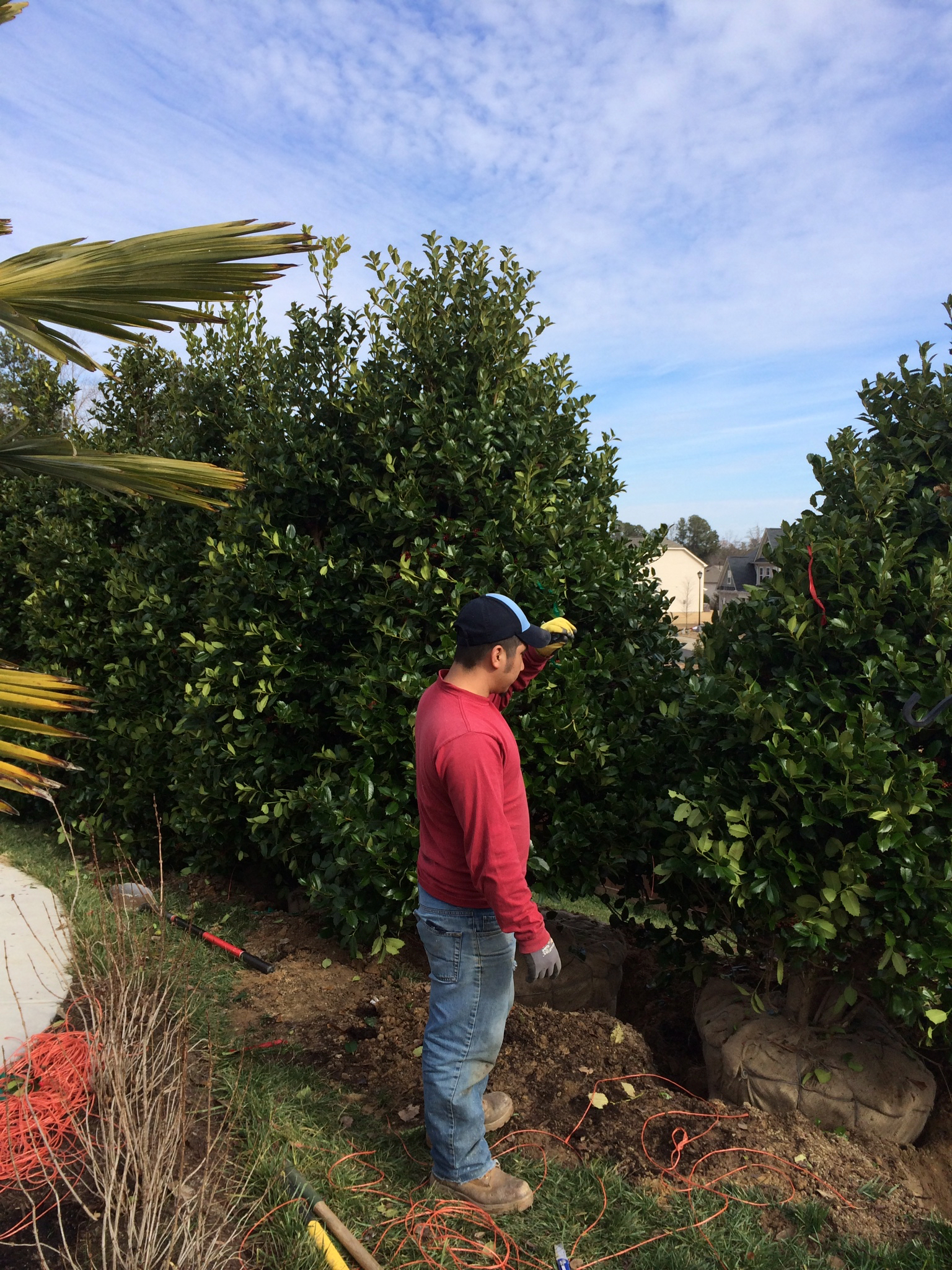 The defining characteristic of a mature specimen-grade plant is size at installation. Where a nursery-grade plant arrives in a container and stands 3 to 5 feet tall, a specimen-grade plant is field-grown and installed at 8, 10, 12, or even 15 feet in height — depending on species and availability.
The practical difference is not subtle. A row of 10-foot Emily Bruner hollies installed along a property line provides immediate, dense, year-round screening. That same row planted from 3-gallon containers would take the better part of a decade to reach the same effect in Zone 7b’s growing conditions.
|
The key insight: Specimen-grade plants cost more per unit than nursery-grade plants — but the cost of waiting five to eight years for privacy, measured in lost enjoyment of your outdoor space, is rarely factored into that comparison. |
At Home & Garden Landscapes, every privacy screen we install uses specimen-grade plnt material specifically because our clients cannot afford to wait. When the installation crew leaves your property, the screen is complete.
Best Plants for Instant Privacy Screening on New Construction Lots
The right plant for your new construction lot depends on your specific conditions — sun exposure, lot size, soil, deer pressure, and HOA restrictions. Below are the top-performing options we install across the Triangle region, matched to common new construction scenarios.
|
Situation |
Best Plant Choice |
Installed Height |
Sun / Shade |
|
Full sun, open boundary |
Nellie Stevens Holly |
8–15 ft |
Full sun |
|
Shaded or wooded line |
Emily Bruner Holly |
8–15 ft |
Full sun to full shade |
|
Max height, fast coverage |
Green Giant Arborvitae |
10–15 ft |
Full sun to part shade |
|
Aesthetic / visible hedge |
Cryptomeria japonica |
8–12 ft |
Full sun to part shade |
|
Large-scale or estate screen |
Southern Magnolia |
12–20 ft |
Full sun to part shade |
Emily Bruner Holly — Best for Shaded Boundaries
Emily Bruner Holly (Ilex × ‘Emily Bruner’) is our most-recommended privacy screening plant for new construction lots in the Triangle region, particularly where shade is a factor. It performs reliably from full sun to full shade — a range no conifer can match — and reaches 20 to 25 feet at maturity with a dense, pyramidal form that provides solid year-round coverage. Hardy in Zones 6 through 9, deer resistant, and completely free of the disease vulnerabilities that plague Leyland cypress, Emily Bruner Holly is the workhorse of new construction privacy screening in NC.
Nellie Stevens Holly — Best for Sunny Exposures
Nellie Stevens Holly (Ilex × ‘Nellie R. Stevens’) is the preferred choice for south- and west-facing property lines where maximum sun is available. It establishes quickly, produces dense glossy foliage year-round, and reaches 15 to 25 feet at maturity. Like Emily Bruner, it is deer resistant and disease resistant — two qualities that matter enormously in newly developed suburban communities where deer pressure is high and the soil environment is stressed.
Green Giant Arborvitae — Best for Maximum Height
For new construction lots on large parcels, or situations where the screening need calls for eventual heights of 30 feet or more, Green Giant Arborvitae (Thuja plicata ‘Green Giant’) is the most effective option. Growth rates of 3 to 5 feet per year mean that even nursery-grade plants close the gap relatively quickly — but installed as specimens at 10 to 15 feet, they provide immediate impact and an accelerated path to mature coverage.
Cryptomeria — Best for Aesthetic Screening
When the privacy hedge is visible from the main living areas of the home and needs to contribute positively to the landscape’s overall design, Cryptomeria japonica is the refined choice. Its soft, feathery texture and gracefully irregular form bring genuine visual character to a screening planting — important in new construction communities where the landscape will be seen every day and where curb appeal matters.
What the Installation Process Looks Like
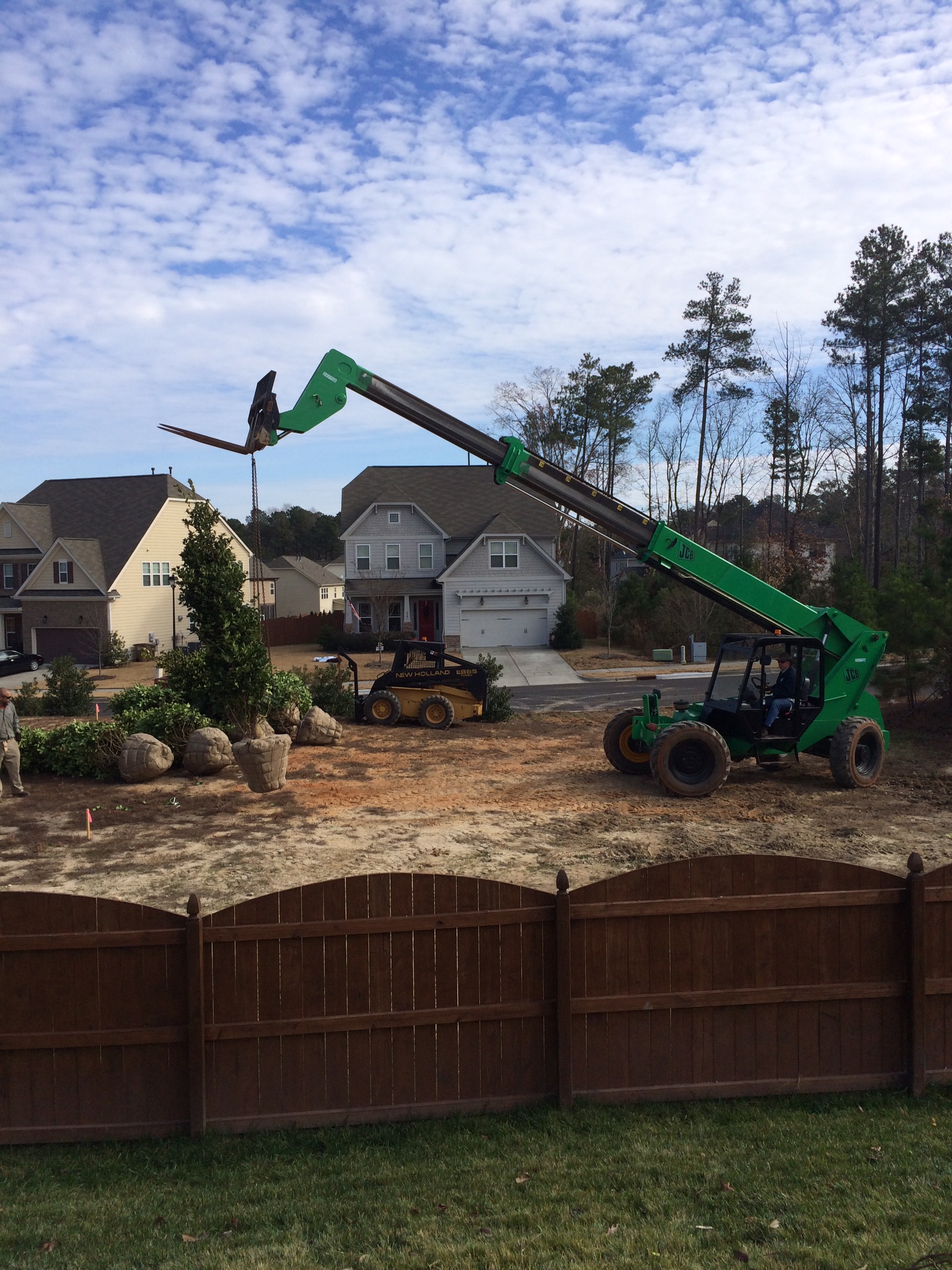
Homeowners who have only experienced conventional landscaping are often surprised by the scope of a mature specimen installation. Moving and establishing large plants requires different equipment, different techniques, and considerably more horticultural knowledge than a standard nursery planting. Here is what the process typically involves:
- Site assessment and consultation — we visit the property to evaluate soil conditions, sun and shade patterns, lot line locations, utility easements, and HOA restrictions before any plant material is selected
- Soil preparation — compacted construction soil is amended before planting to ensure root establishment; this step is frequently skipped by general landscapers and is one of the most important predictors of long-term plant health
- Plant sourcing — specimen-grade material at the heights required for immediate screening is sourced from our specialty grower network; availability varies by species and season
- Installation — mature specimens require proper equipment for delivery and placement; our crews handle the full process from site preparation through final positioning and establishment watering
- Aftercare guidance — newly installed specimen-grade plants require consistent moisture through their first growing season; we provide specific care instructions for every installation
For most residential new construction privacy screen installations in the Triangle region, the full process from initial consultation to completed installation takes two to four weeks.
How Much Does Instant Privacy Screening Cost?
The honest answer is that cost varies significantly based on the length of the screen, the species selected, the sizes required, and site conditions. Specimen-grade plants are priced differently from nursery-grade plants, and installations that require significant soil preparation or equipment access add to the overall scope.
What we can say with confidence is that the cost of a properly installed specimen-grade privacy screen — one that functions as a finished screen from day one — is almost always less than the cumulative cost of planting small, waiting years, replanting failures, and deferring the enjoyment of the outdoor spaces you purchased the property for.
We offer free on-site consultations throughout the Triangle region. A consultation gives us the information we need to provide an accurate project assessment and recommendation — and gives you the information you need to make a confident decision.
Ready to Stop Waiting for Privacy?
Home & Garden Landscapes has been installing mature specimen-grade privacy screens for new construction homeowners across Raleigh, Durham, Chapel Hill, Cary, Apex, Wake Forest, and the greater Triangle region since 2002. Our team holds advanced horticultural credentials from NC State University and operates under NC Licensed Landscape Contractor License #2591.
If you have just moved into a new home and are living with the exposure that comes with new construction, we can help — and we can have a finished privacy screen installed faster than you might expect.
Call 919-801-0211 to schedule your free on-site consultation.
NC Licensed Landscape Contractor · NCLC #2591 · homeandgardenlandscapes.com