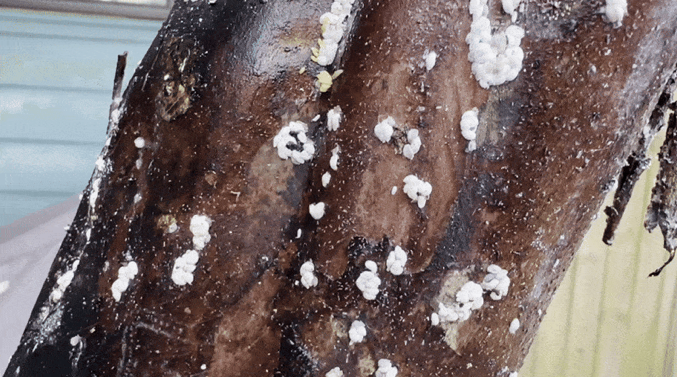
 If your crape myrtles have developed a white or gray crusty coating on the bark — and if black sooty mold has followed — you are looking at crape myrtle bark scale (CMBS), the most significant new pest threat to one of the Triangle’s most beloved ornamental trees. CMBS has been spreading steadily across North Carolina since it was first confirmed in the state, and it is now well-established in the Raleigh, Durham, Chapel Hill, and Cary areas.
The good news: crape myrtle bark scale is treatable. Trees that are correctly identified and treated on the right timeline can fully recover. The bad news: many homeowners misdiagnose the problem, apply the wrong treatment, or delay too long — allowing the infestation to reach a severity that is much harder to reverse.
This guide covers everything Triangle-area homeowners need to know: what crape myrtle bark scale is, how to identify it, what it does to your trees over time, and how to treat and manage it effectively in Zone 7b conditions.
What Is Crape Myrtle Bark Scale?
Crape myrtle bark scale (Acanthococcus lagerstroemiae, formerly Eriococcus lagerstroemiae) is a felt scale insect native to Asia. It was first detected in the United States in Texas in 2004 and has since spread across much of the Southeast. In North Carolina, CMBS has been confirmed in most Piedmont counties and is continuing to expand its range.
Unlike many pest insects that attack weakened or stressed plants, crape myrtle bark scale can and does infest healthy, well-established crape myrtles. It is not a sign that your trees were planted incorrectly or are otherwise compromised — it is an opportunistic invasive pest that specifically targets Lagerstroemia species and a small number of closely related plants.
The scale feeds by inserting a stylet (a needle-like mouthpart) into the phloem tissue of the bark and extracting plant sap. This feeding depletes the tree’s resources and, at high infestation levels, can noticeably reduce flowering, weaken branch structure, and stress the tree in ways that make it more susceptible to secondary problems.
How to Identify Crape Myrtle Bark Scale
CMBS is one of the easier landscape pests to identify once you know what you are looking for. The challenge is that many homeowners notice the sooty mold — which is secondary and highly visible — before they notice the scale itself.
The Primary Symptom: White or Gray Felt-Like Crust on Bark
Crape myrtle bark scale colonies appear as white to pale gray felt-like or waxy encrustations on the bark. They colonize most heavily at branch crotches, on smaller stems, and at pruning wounds, but at high infestation levels they can cover large sections of the main trunk and major scaffold branches.
When you press or crush an active scale colony with your finger, you will see pink or reddish fluid — this is the characteristic field test that distinguishes CMBS from other bark discolorations. No other common crape myrtle problem produces this pink crush test result.
The Secondary Symptom: Black Sooty Mold
Like many sap-feeding insects, CMBS excretes honeydew — a sticky, sugar-rich waste product — as it feeds. This honeydew coats bark, branches, and often the leaves and any surfaces below the tree, and it serves as a growth medium for sooty mold fungi. The result is the black or dark gray coating that often alerts homeowners to a problem before they locate the scale itself.
Sooty mold does not directly harm the tree tissue it grows on, but in severe cases it can reduce photosynthesis in foliage. More practically, it makes affected trees look seriously unhealthy and can blacken pavement, furniture, and other surfaces beneath the canopy.
What CMBS Is Not
Several common crape myrtle conditions are mistaken for scale:
- Powdery mildew — a fungal disease that produces a white powdery coating on leaves and young shoots, not on bark. Powdery mildew is encouraged by low air circulation and moderate temperatures; it does not produce the pink crush test.
- Lichen — crusty gray-green or silvery patches on bark that are a symbiotic relationship of algae and fungi. Lichen does not produce pink fluid when crushed and is not harmful to the tree.
- Normal bark coloration and exfoliation — crape myrtle bark naturally exfoliates in attractive patches of tan, cinnamon, and gray. This peeling bark is a feature of the tree, not a symptom of disease or pest damage.
If in doubt, the pink crush test is your field diagnostic. CMBS is the only common crape myrtle pest that produces it.
Crape Myrtle Bark Scale: Quick Identification Reference
|
Symptom |
CMBS |
Likely Alternative |
|
White coating on bark |
Felt-like, waxy crust; pink when crushed |
Lichen (no pink fluid); powdery mildew (on foliage only) |
|
Black coating |
Sooty mold on honeydew from scale feeding |
May also follow aphid infestation |
|
Location on tree |
Branch crotches, stems, trunk; pruning wounds |
Powdery mildew: foliage and new growth only |
|
Pink crush test |
Yes — diagnostic for CMBS |
No other common crape myrtle condition produces this |
|
Reduced flowering |
Yes, at moderate to high infestation levels |
Powdery mildew: can also reduce flowering |
What Crape Myrtle Bark Scale Does to Your Trees
A light CMBS infestation on an otherwise healthy, established crape myrtle may be nearly invisible and cause minimal impact. But the pest reproduces rapidly, overwinters on the bark, and builds population pressure year over year if left untreated. Understanding the progression helps explain why early treatment produces dramatically better outcomes than waiting.
Year 1–2: Early Infestation
Early colonies are small and concentrated in branch crotches and at pruning sites. Flowering is generally not yet affected, and the tree’s overall vigor remains normal. At this stage, treatment is highly effective and recovery is fast. Many homeowners miss this window entirely because the symptoms are subtle — a bit of white crust in branch angles that is easily overlooked.
Year 2–4: Moderate Infestation
As the population expands, colonies spread to larger stem sections and the main scaffold branches. Honeydew production increases, and sooty mold becomes conspicuous — often this is when homeowners first realize something is wrong. Flowering is noticeably reduced, and the aesthetic impact of sooty mold becomes significant. Treatment at this stage is still very effective but requires more thorough application and may take a full growing season to show full results.
Year 4+: Heavy Infestation
At heavy infestation levels, the entire canopy framework may be encrusted, sooty mold is pervasive, and the tree’s energy resources are being substantially depleted. Flowering can be severely reduced or essentially absent. Trees at this stage are also more susceptible to drought stress and secondary pathogens. Treatment remains possible and worthwhile for established specimen trees, but recovery takes longer and requires consistent follow-up.
|
The key takeaway: crape myrtle bark scale is a progressive problem. A tree with a light infestation today will have a moderate to heavy infestation in two to three years without treatment. Early identification and prompt treatment produce the best outcomes and the lowest treatment cost over time. |
How to Treat Crape Myrtle Bark Scale
Effective CMBS management typically involves a combination of physical removal, systemic insecticide treatment, and monitoring. No single application eliminates the pest permanently — ongoing attention, particularly in the early spring before egg hatch, is part of a realistic management program.
Physical Removal: Scrubbing
For accessible bark on smaller trees or lower trunk sections, physical scrubbing with a soft brush and diluted dish soap solution can remove scale colonies directly. This is most effective as a supplemental step rather than a standalone treatment. Scrubbing reduces the scale load on the bark and removes some of the sooty mold, but it does not reach scale populations in branch crotches and upper canopy without significant effort.
For specimen-grade trees or those in prominent landscape locations, scrubbing the accessible portions of the trunk in late winter — before the growing season begins — can meaningfully reduce the starting population ahead of systemic treatment.
Systemic Insecticide: Soil Drench or Trunk Injection
The most effective treatment for established CMBS infestations is a systemic imidacloprid application — either as a soil drench around the root zone or as a trunk injection. Imidacloprid is taken up through the roots (or trunk, in the case of injection) and distributed throughout the tree’s vascular system, where it is ingested by the scale insects as they feed.
Timing matters: applications in late April through May — as the tree is actively growing and before the first generation of crawlers (the mobile, newly hatched juvenile scale) is in full activity — produce the strongest uptake and the most effective control. Soil drench applications should be made to moist soil for optimal absorption.
Important: Imidacloprid is a systemic insecticide with known effects on pollinators, including bees, that visit flowers. Crape myrtles are pollinator-visited plants. Applications timed to late spring — before bloom — minimize exposure risk, but this is a consideration that professional applicators factor into treatment planning.
Horticultural Oil: Overwintering Population Suppression
A dormant-season application of horticultural oil (applied in late winter before bud break) can smother overwintering scale and reduce the starting population for the growing season. This is most useful as part of a multi-year management program rather than a one-time intervention. Horticultural oil must achieve good coverage of bark surfaces to be effective — large or heavily infested trees are difficult to treat this way without professional equipment.
What Does Not Work
Several common interventions are either ineffective against CMBS or counterproductive:
- Contact insecticide sprays applied to bark — scale insects are protected by their waxy covering; contact sprays that do not reach the crawler stage at the right window have minimal effect on established colonies.
- “Crape murder” (severe topping) as a response to scale — hard pruning creates large fresh wounds that actually provide ideal colonization sites for new scale populations and compounds the tree’s stress.
- Treating sooty mold directly — sooty mold is a symptom, not the cause. It will resolve as scale populations are controlled and honeydew production decreases; treating the mold without treating the scale provides only cosmetic and temporary improvement.
Crape Myrtle Scale in the NC Triangle: What to Expect
CMBS is present and spreading in Wake, Durham, Orange, and Chatham counties. If you have established crape myrtles and have not examined the bark recently, a close inspection in late winter or early spring — when scale colonies are visible and dormant oil treatment is timed — is a worthwhile annual practice.
The pest spreads primarily through movement of infested plant material, but it also spreads short distances by crawler movement and on the bodies of birds and other animals that contact infested bark. Once CMBS is established in a neighborhood, nearby trees are at meaningful risk. Treating an infested tree promptly reduces the population available to spread to adjacent plants.
Zone 7b temperatures do not reliably suppress CMBS. The pest overwinters successfully in our climate and resumes activity reliably in spring. Management is an ongoing process, not a one-time intervention.
Do Some Crape Myrtle Cultivars Resist Scale Better Than Others?
Research on CMBS cultivar susceptibility is still developing, but preliminary data and field observations suggest that while no Lagerstroemia cultivar is immune, some show meaningful differences in susceptibility. The following reflects current understanding — not definitive resistance ratings.
|
Cultivar |
Relative Susceptibility |
Notes |
|
Natchez |
Lower |
One of the more frequently cited cultivars with lower observed infestation rates; excellent specimen tree |
|
Muskogee |
Lower to moderate |
Lavender-flowering large-form cultivar; widely planted in Triangle |
|
Tuscarora |
Moderate |
Coral-pink; popular in residential landscapes |
|
Dynamite |
Moderate to higher |
Red-flowering; widely planted; monitor closely |
|
Acoma |
Lower |
Compact weeping white; frequently performs well |
|
Tonto |
Moderate |
Compact fuchsia-red; inspect branch crotches carefully |
Note: cultivar susceptibility data should be treated as a general guide, not a guarantee. Environmental conditions, tree health, and local pressure all influence infestation outcomes. Annual inspection remains important regardless of cultivar.
When to Call a Professional
Crape myrtle bark scale management is well within the capabilities of attentive homeowners for trees in the early stages of infestation. But several situations warrant professional assessment and treatment:
- Large specimen trees with heavy infestations — effective systemic treatment of a 20-to-25-foot multi-trunk specimen requires proper equipment and application rates that are difficult for homeowners to achieve with off-the-shelf products.
- Multiple trees affected across a property — coordinated treatment timing and application produce better results than piecemeal homeowner applications.
- Trees with compound problems — scale plus secondary stress (drought, root damage, compaction) requires a management approach that addresses the full picture, not just the pest.
- Uncertainty about diagnosis — before treating, confirm you are dealing with CMBS. Misdiagnosis wastes money and delays effective intervention. A professional can confirm scale, assess infestation severity, and recommend a treatment sequence appropriate to the specific tree and situation.
Home & Garden Landscapes works with licensed applicators for pest management treatments and can assess your crape myrtles as part of a landscape consultation. We also provide professional pruning, corrective work, and soil remediation for trees recovering from scale damage.
|
The specimen tree standard: an established, well-positioned crape myrtle represents a meaningful landscape investment. A Natchez or Muskogee specimen at 15 to 20 feet, correctly installed, contributes structure, seasonal color, and character that takes years to build. Treating CMBS promptly protects that investment. Replacing a mature specimen — if it cannot be saved — costs far more than treatment. |
Concerned About Your Crape Myrtles? Let’s Take a Look.
Home & Garden Landscapes has been serving the Raleigh, Durham, Chapel Hill, Cary, Apex, Wake Forest, and greater Triangle region since 2002. We know the plants and the pest pressures of NC Zone 7b — including crape myrtle bark scale, which we are seeing with increasing frequency on established residential specimens across the Triangle.
If you have noticed white crust, sooty mold, or reduced flowering on your crape myrtles — or if you simply want your crape myrtles inspected as a preventive measure — call us for a free consultation.
Call 919-801-0211 to schedule your free consultation.
NC Licensed Landscape Contractor · NCLC #2591 · homeandgardenlandscapes.com