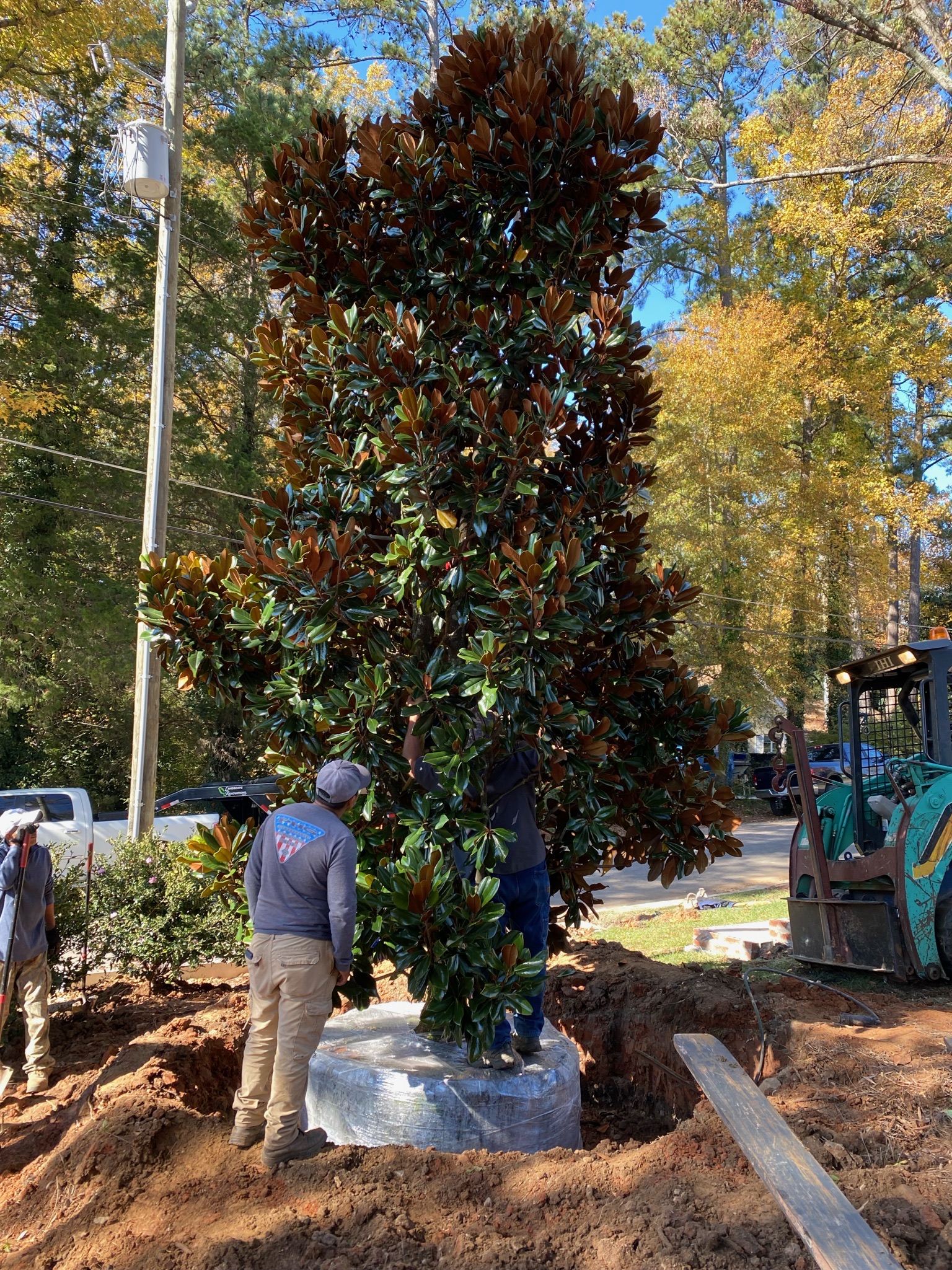
 After a long, hot Triangle summer, the drought is finally breaking — and for anyone who watched their landscape struggle through weeks of 90-degree heat and little rain, the timing could not be better. Because in the North Carolina Piedmont, the single best window of the entire year to plant trees and shrubs is not spring. It is fall. The weeks between the end of summer drought and the first hard freeze are when woody plants establish most successfully, with the least stress and the fastest payoff the following spring. This guide explains why fall planting works so well in Zone 7b/8A, what to plant now, what to hold until spring, and how to give new installations the strongest possible start.
Why Fall Is the Best Time to Plant in the NC Piedmont
Most homeowners assume spring is planting season — it is when garden centers fill up and the urge to be outside returns. But in the Southeast, spring planting sends young plants straight into the hardest season of the year. A shrub planted in April has only a few weeks to establish roots before it is hit with the full force of a Piedmont summer: 95-degree heat, radiant load off pavement and walls, and the extended dry spells that define July and August.
Fall reverses that equation. A tree or shrub planted in October has months of mild, moist conditions ahead of it before it faces any real stress. Air temperatures drop, but Piedmont soil stays warm well into winter — and warm soil paired with cool air is exactly the combination roots need. The plant is no longer spending energy on top growth; it channels nearly everything into building a root system while conditions are forgiving. By the time the following summer arrives, a fall-planted specimen already has a full season of root development behind it and is far better equipped to handle heat and drought than anything planted in spring.
The Drought Is Breaking — And That Changes the Soil Beneath Your Feet
The end of a summer drought is not just a relief for stressed plants — it fundamentally changes planting conditions. Through the peak of a Piedmont drought, clay soils compact and harden, shedding what little rain does fall rather than absorbing it. Digging a proper planting hole in bone-dry August clay is difficult, and backfilled soil around a new root ball dries out almost immediately.
As fall rains return and soak into the profile, that clay rehydrates and becomes workable again. Planting holes hold moisture. New root balls stay hydrated between waterings instead of wicking dry. And the natural rainfall of autumn does much of the irrigation work that a homeowner would otherwise have to do by hand in summer. In short, the drought breaking is the starting gun for the best planting stretch of the year — a window that typically runs from early fall until the ground begins to freeze.
The Science of Fall Root Establishment
Why fall works comes down to what a plant does with its energy. Woody plants continue growing roots as long as soil temperatures stay above roughly 40°F — which, in the Triangle, means root activity continues well into December and often resumes on mild winter days. Above ground, deciduous plants drop their leaves and evergreens slow dramatically, so the plant’s water demand falls sharply. The result is a plant investing almost entirely in below-ground establishment during exactly the months when the weather cooperates.
By spring, that fall-planted tree or shrub will have a head start because it has been establishing a root system over the winter months — ready to support a full flush of new top growth the moment the season turns. A spring-planted specimen, by contrast, has to build roots and push new growth at the same time, right as heat and drought pressure begin to mount.
|
The one-season head start: A tree planted in October has roughly six to eight months of root establishment behind it before its first Piedmont summer. The same tree planted in April has six to eight weeks. That difference is the single biggest reason fall-planted material outperforms spring plantings through their first hot season. |
What to Plant in Fall in the Triangle
Fall is the ideal window for the large majority of trees and shrubs installed in NC Piedmont landscapes — anything reliably hardy in Zone 7b:
- Evergreen privacy screening — Emily Bruner and Nellie Stevens holly, ‘Green Giant’ arborvitae, cryptomeria, and Eastern red cedar all establish well from fall installation, gaining a full root season before summer.
- Shade and canopy trees — Native oaks (willow oak, white oak), maples, and other deciduous canopy trees establish beautifully when planted in fall.
- Broadleaf evergreen shrubs — Hollies, cleyera, loropetalum, cherry laurel, and foundation plantings go in ideally during the fall window.
- Specimen and ornamental trees — Southern magnolia cultivars, Japanese maples, and crape myrtles all take well to dormant-season planting.
- Spring bulbs and hardy perennials — Fall is the correct time to plant spring-flowering bulbs and to divide or install most cold-hardy perennials.
|
What to Plant in Fall |
Examples |
Why Fall Works |
|
Evergreen screening |
Emily Bruner holly, Nellie Stevens holly, ‘Green Giant’, cryptomeria |
Full root season before summer heat and drought |
|
Shade / canopy trees |
Willow oak, white oak, red maple |
Deep-rooting trees benefit most from the head start |
|
Broadleaf evergreen shrubs |
Hollies, cleyera, loropetalum, Laurels |
Establish through the mild, moist fall window |
|
Specimen & ornamental trees |
Southern magnolia, Japanese maple, crape myrtle |
Dormant-season planting reduces transplant stress |
|
Bulbs & hardy perennials |
Daffodils, tulips, liriope, native perennials |
Fall is the natural planting time for these |
What to Hold Until Spring
A few categories are better installed in spring, after the last hard freeze:
- Cold-tender or marginal plants — Cold-hardy palms (Windmill palm), tender tropicals, and anything at the edge of Zone 7b hardiness benefit from a full growing season to establish before facing their first winter.
- Warm-season turfgrass — Zoysia and Bermuda establish in late-spring and early-summer heat, not in fall.
- Tender perennials — Some tender perennials and summer annuals are simply spring-and-summer plants.
The safest rule of thumb: anything marginal for our winters should go in during spring, and anything reliably hardy in Zone 7b is an excellent fall candidate. When you are unsure where a specific plant falls, our assistant Sprout or a quick consultation call can settle it.
Fall vs. Spring Planting: Side by Side
|
Factor |
Fall Planting |
Spring Planting |
|
Air temperature |
Cool and dropping — low plant stress |
Warming toward summer heat |
|
Soil temperature |
Warm well into winter — roots keep growing |
Cold early, warms slowly |
|
Water demand |
Low; natural rainfall does much of the work |
Rising fast as heat arrives |
|
Establishment time before summer |
6–8 months |
6–8 weeks |
|
Best for |
Nearly all Zone 7b hardy trees & shrubs |
Marginal, tender, and warm-season plants |
How to Give Fall Plantings the Strongest Start
Even in ideal fall conditions, establishment technique matters:
- Test and amend the soil — The NC State Extension soil test is free from October through March. It tells you whether the site needs lime or amendment before planting — the lowest-cost, highest-return step available.
- Mulch 3 to 4 inches — A 3-to-4-inch layer of organic mulch insulates the root zone, keeping soil warm longer so roots keep growing later into the season. Keep mulch 2–3 inches off the trunk.
- Water deeply until the ground freezes — New plants still need water in fall and on mild winter days — do not assume rain has it covered. Water deeply at the drip line until the ground freezes.
- Skip the fertilizer — Hold nitrogen fertilizer until spring. Pushing top growth in fall works against the root establishment that makes fall planting so effective.
Now Is the Time — Here’s How to Start
The fall planting window is real, but it is finite. The best specimen material moves quickly once the season opens, and installation calendars fill fast between the drought breaking and the first freeze. There are three easy ways to get started:
- Browse the online catalog — See what is available for your site and season in our online plant catalog at homeandgardenlandscapes.com — from privacy screening and specimen trees to broadleaf evergreens and ornamentals.
- Chat with Sprout — Ask Sprout, our AI plant assistant trained specifically for the NC Triangle — Zone 7b, our clay soils, our heat and deer pressure. Sprout can help you figure out whether a plant is a fall or spring candidate and what will work in your yard, free and anytime, at homeandgardenlandscapes.com/ask-sprout/.
- Book a free consultation — Ready to move from questions to a plan? Call 919-801-0211 to schedule a free consultation while the fall window is open.
Work With Home & Garden Landscapes
Since 2002, Home & Garden Landscapes has provided licensed landscape contracting services (NCLC #2591) across the Raleigh-Durham-Chapel Hill Triangle — Cary, Apex, Wake Forest, Hillsborough, and the surrounding Piedmont. We specialize in specimen-grade trees, privacy screening, and landscape renovation matched precisely to Zone 7b conditions. Fall is the best planting stretch of the year in our region, and now — with the summer drought breaking — is the moment to take advantage of it.
Browse the catalog, chat with Sprout™ , or call 919-801-0211 to schedule your free consultation.