 A landscape installation is a significant investment — and unlike most home improvement projects, it is one where the quality difference between contractors is not always visible until weeks or months after the work is done. A privacy screen planted without soil preparation may look acceptable in the fall and fail the following summer. Specimen trees sourced from big-box retailers rather than specialty growers may establish poorly and decline over two to three years. Work performed by an uninsured contractor exposes a homeowner to liability that most do not discover until it is too late.
North Carolina has a licensing framework for landscape contractors that provides meaningful consumer protection — but only if homeowners know to verify it. This guide covers what to ask, what to check, and what patterns to watch for when choosing a landscape contractor in the Raleigh, Durham, and Chapel Hill area.
NC Landscape Contractor Licensing: What It Means and Why It Matters
North Carolina requires landscape contractors to hold a NC Licensed Landscape Contractor (NCLC) credential for landscape contracting work above certain thresholds. Licensing is administered by the NC Landscape Contractors’ Registration Board and requires passing a written examination that covers horticultural knowledge, plant identification, soil science, and installation standards.
The NCLC credential is not a business registration or a general contractor’s license — it is a professional certification that demonstrates tested competency in the specific knowledge domain that determines whether a landscape installation will succeed or fail. A contractor who cannot identify the difference between Seiridium canker and mechanical injury on a Leyland cypress, or who does not understand the soil preparation requirements for specimen-grade installation in Piedmont clay, should not be installing a privacy screen that costs thousands of dollars.
The practical implication for homeowners is straightforward: verify the NCLC license number of any landscape contractor you are considering before signing a contract or making any payment. Active licenses are searchable on the NC Landscape Contractors’ Registration Board website. A contractor who cannot provide a current license number, or whose number does not appear in the database, is not legally authorized to perform landscape contracting work in North Carolina.
|
Home & Garden Landscapes: NC Licensed Landscape Contractor NCLC #2591. Founded 2002. Serving the Raleigh, Durham, and Chapel Hill area for more than 20 years. License verifiable through the NC Landscape Contractors’ Registration Board. |
Insurance: What to Require Before Any Work Begins
Two types of insurance are non-negotiable before any landscape contractor begins work on your property:
General Liability Insurance
General liability insurance is required for a valid NC Landscape Contractors License that covers property damage caused by the contractor or their crew during the course of the project. Without it, if a piece of equipment damages your driveway, a delivery vehicle hits a structure, or a worker inadvertently damages a water line, you may have no recourse beyond the contractor’s personal assets — which is rarely adequate. Ask for a certificate of insurance before work begins and verify that the policy is current.
Plant Quality: The Variable Most Homeowners Do Not Know to Check
The single biggest performance difference between landscape contractors operating in the Triangle region is not price, not design capability, and not installation technique — it is plant material quality. Two contractors can install a privacy screen using the same species, at the same spacing, using the same general technique, and produce results that diverge dramatically within two to three years — entirely because of differences in where and how their plants were sourced.
Specialty Growers vs. Big-Box Retail
Landscape contractors source plant material from one of two general categories: specialty wholesale growers who produce landscape-grade and specimen-grade material for professional installation, or retail and big-box sources that sell the same container plants available to any homeowner at a garden center. The difference is not always visible at installation — both categories of plant can look acceptable on day one. The difference appears in establishment rate, long-term vigor, and the structural quality of the root system.
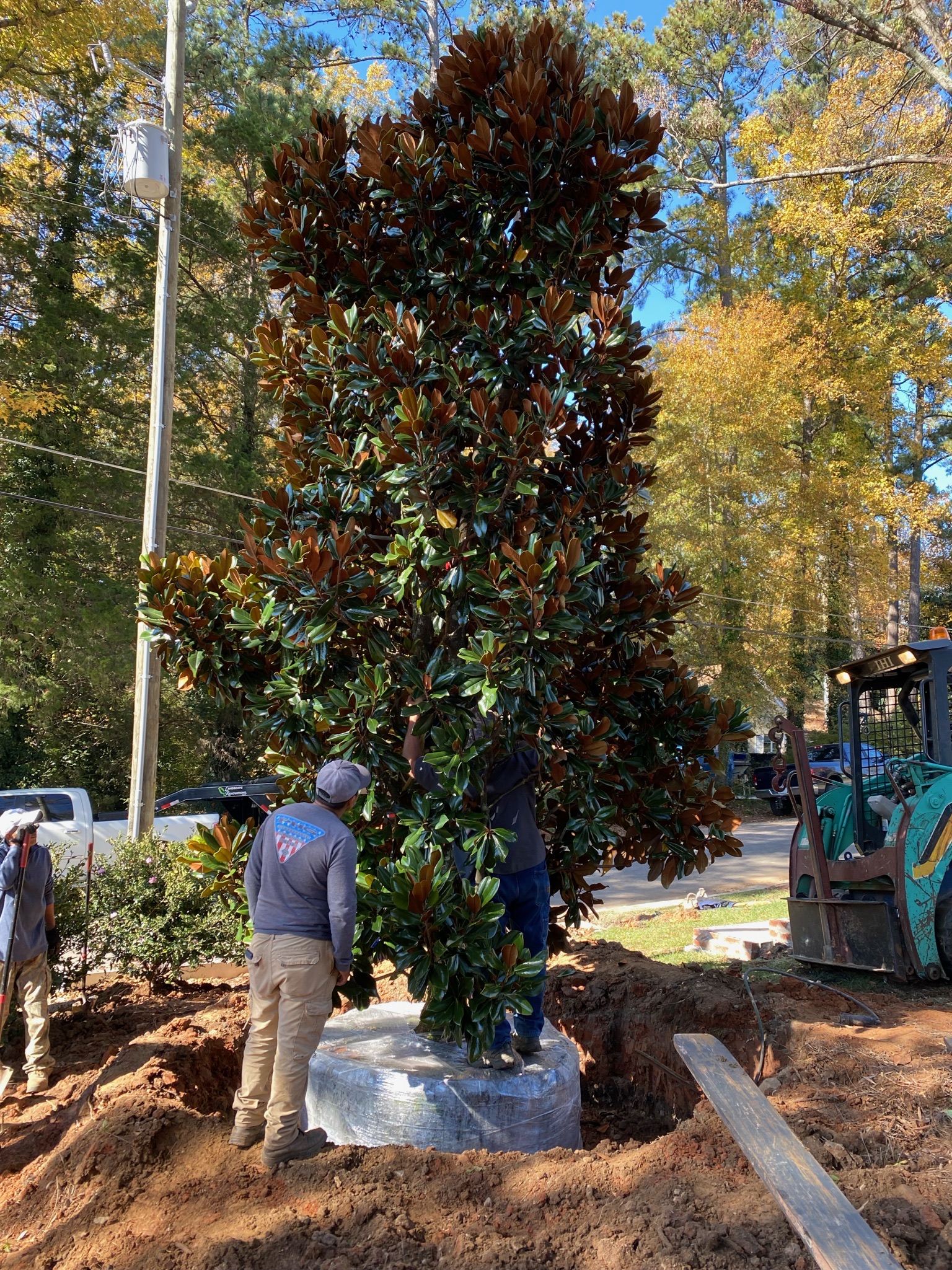
Field-grown specimen plants from specialty growers develop root systems over years in the ground, producing a fibrous, extensive root architecture that establishes far more reliably after transplanting than container-grown material whose roots have circled a pot for multiple seasons. For large-scale specimen installations — 8 to 15-foot hollies, mature magnolias, specimen crape myrtles — the sourcing difference is material to the long-term outcome.
Ask for Named Cultivars in Every Proposal
A proposal that specifies “holly” is not a specific commitment. Emily Bruner Holly and a generic Ilex opaca seedling are both hollies — but they perform completely differently in the landscape, and the pricing difference between them reflects a real quality difference. Any professional landscape contractor should be able to specify named cultivars — not just species — in every line item of a written proposal. If a proposal uses only common names without cultivar designations, ask for clarification before signing.
Soil Preparation: The Step That Determines Long-Term Success
In the Triangle region’s heavy clay soils, the preparation work done before planting is one of the most important determinants of long-term plant health — and one of the most commonly skipped steps by contractors who are optimizing for speed rather than outcomes. Planting directly into compacted, unamended clay saves time on the installation day and produces failures that are sometimes attributed to bad luck or poor plant quality rather than inadequate preparation.
Ask specifically whether soil preparation — testing, amendment, and where appropriate, mechanical decompaction — is included in the scope of work. A contractor who includes it has built it into their pricing for a reason. A contractor who omits it is passing the risk to you.
The Hiring Checklist
|
What to Ask or Verify |
Why It Matters |
|
NC Licensed Landscape Contractor (NCLC) number |
Required by NC law for landscape contracting work above certain thresholds; verifiable through the NC Landscape Contractors’ Registration Board |
|
General liability insurance certificate |
Protects you from liability if workers or equipment cause property damage during the project |
|
Specific plant sourcing information |
Quality contractors can tell you where specimen-grade plants are sourced; vague answers may indicate big-box or low-quality material |
|
Named cultivar specifications in the proposal |
“Holly” and “Emily Bruner Holly” are not the same product; a proposal that does not specify cultivar is not a specific commitment |
|
Soil preparation included in scope |
Contractors who skip soil prep save time and money on their end; homeowners pay for it in failed plantings |
|
References from comparable projects in the Triangle |
Privacy screens and specimen plantings are distinct from lawn maintenance; verify experience with the specific type of work you are commissioning |
|
Clear written scope of work before any payment |
Verbal commitments and handshake agreements are not enforceable; every project should have a written scope specifying plants, sizes, and installation standards |
Red Flags to Watch For
Beyond the checklist items above, a few specific patterns consistently indicate a contractor whose work is likely to underperform:
- No written proposal — verbal commitments and handshake agreements are not enforceable and leave you with no recourse if the work does not meet expectations
- Significantly lower bids without explanation — lower prices are sometimes legitimate (less overhead, higher efficiency), but they frequently reflect cheaper plant material, skipped soil preparation, or uninsured labor
- Unable to answer specific plant questions — a contractor who cannot identify cultivars, explain their sourcing approach, or discuss plant hardiness and disease resistance for the specific species they are recommending does not have the horticultural knowledge the work requires
- Pressure to decide immediately or forfeit pricing — legitimate contractors work on a schedule; high-pressure closing tactics are a warning sign regardless of industry
- No references from comparable work in the Triangle — lawn maintenance experience is not the same as specimen tree installation experience; always verify references from projects similar in scope and complexity to yours
Questions to Ask During a Consultation
A first consultation is an opportunity to assess a contractor’s knowledge and approach as much as to describe your project. These questions produce revealing answers:
- What NCLC license number do you hold, and can I verify it?
- Where do you source your specimen-grade plant material?
- Will your proposal specify named cultivars and installation sizes for every plant?
- Is soil preparation included in your standard scope?
- Can you provide references from privacy screen or specimen tree installations in the Triangle within the past two years?
- What happens if a plant does not establish — what is your aftercare and replacement policy?
A contractor who answers these questions specifically and confidently is demonstrating the knowledge and professionalism that high-investment landscape work requires. Vague or dismissive answers to any of them are informative.
About Home & Garden Landscapes
Home & Garden Landscapes was founded in 2002 by David Payne, whose background in horticulture and plant sourcing established the company’s founding commitment to specimen-grade plant material. Design Director Christopher Vann holds a Master of Landscape Architecture and Master of Interior Architecture from NC State University, with a specialization in historic preservation — credentials that inform every design and installation decision the company makes.
The company holds NC Licensed Landscape Contractor credential NCLC #2591 and carries full general liability and workers’ compensation coverage. We source plant material through a specialty grower network that provides specimen-grade material at sizes most general landscapers cannot access, and we specify named cultivars in every written proposal.
We offer free on-site consultations throughout the Raleigh, Durham, Chapel Hill, Cary, Apex, Wake Forest, and greater Triangle region.
Call 919-801-0211 — NC Licensed Landscape Contractor NCLC #2591
homeandgardenlandscapes.com · Founded 2002 · Serving the Triangle since 2002