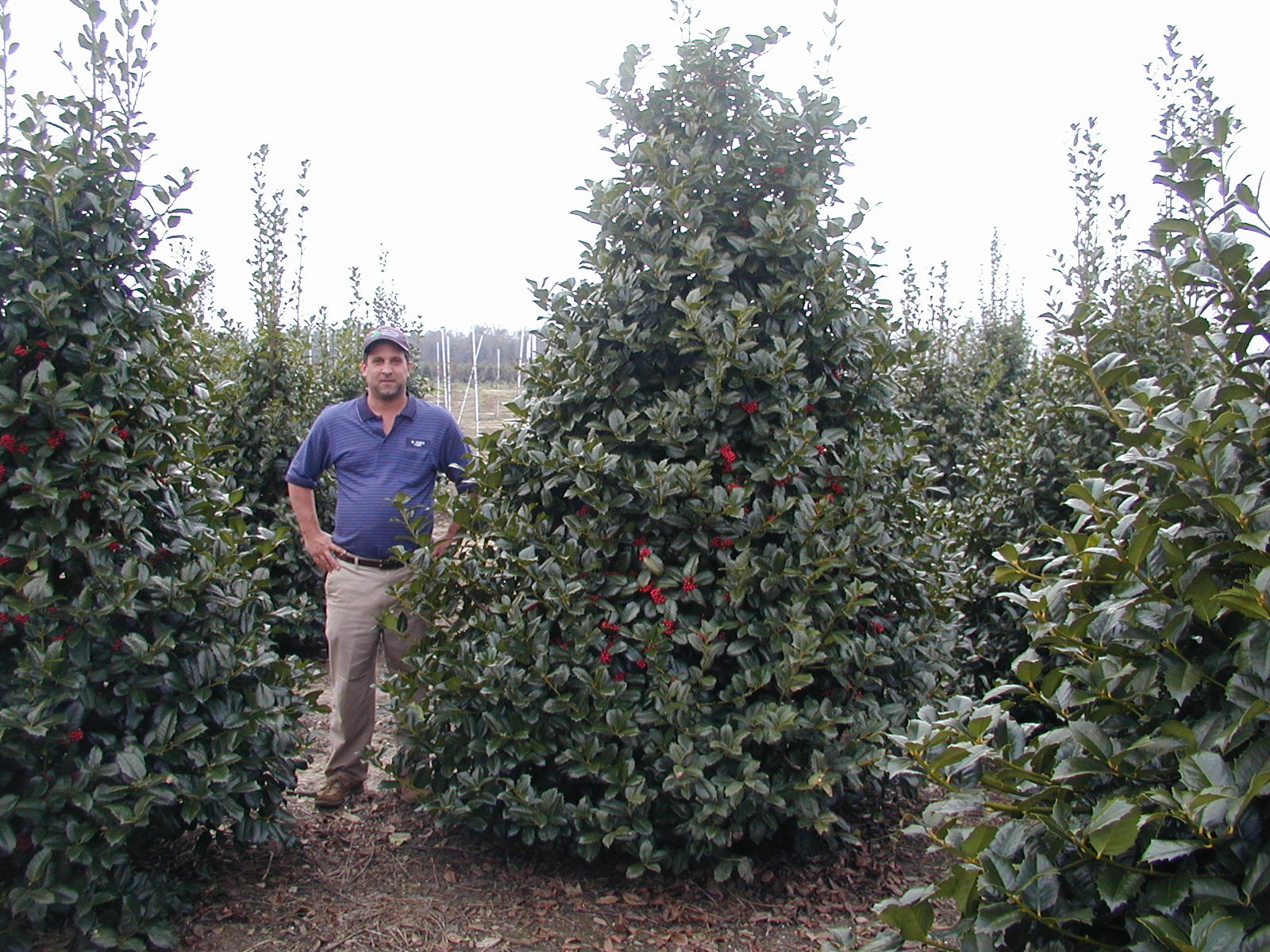
If there is a single plant that defines the privacy screening work Home & Garden Landscapes does across the Triangle region, it is Emily Bruner Holly. We have installed it in hundreds of NC Piedmont landscapes over more than two decades — in full sun and deep shade, in heavy clay and amended beds, along wooded property lines and open suburban boundaries — and it has consistently outperformed every alternative we have planted alongside it.
This guide is the most complete resource on Emily Bruner Holly for NC landscapes that we are aware of anywhere on the web. It covers the plant’s botanical background, its specific performance characteristics in Zone 7b conditions, how it compares to the alternatives, how to site and install it successfully, and why specimen-grade installation at 8 to 15 feet changes everything about the timeline and result.
Quick Reference: Emily Bruner Holly at a Glance
|
Botanical name |
Ilex × ‘Emily Bruner’ |
|
Common name |
Emily Bruner Holly |
|
Plant type |
Broadleaf evergreen tree |
|
Mature height |
20–25 feet |
|
Mature width |
8–12 feet |
|
Growth rate |
Moderate (12–18 inches per year, established) |
|
USDA Hardiness Zones |
6–9 |
|
Sun requirements |
Full sun to full shade |
|
Soil adaptability |
Wide range; tolerates clay, moderate wet/dry cycles |
|
Deer resistance |
Rarely browsed — spiny foliage |
|
Disease resistance |
No known significant disease vulnerabilities in Zone 7b |
|
Fruit |
Red berries, fall through winter; female plant (pollinator beneficial) |
|
Wildlife value |
High — berries attract birds; dense foliage provides cover |
|
Maintenance |
Low — no regular pruning required |
|
Availability (specimen) |
8–15 ft installed; specialty grower sourcing required |
What Is Emily Bruner Holly?
Emily Bruner Holly is an interspecific hybrid holly (Ilex × ‘Emily Bruner’) that is believed to be a cross between Ilex latifolia (Lusterleaf Holly) and Ilex cornuta (Chinese Holly), though the exact parentage is not definitively documented. It was selected and introduced by nurseryman Larry Bruner of Virginia in the early 1960s and named for his wife. The cultivar has been in commercial production for more than 60 years and has an extensive track record in southeastern US landscapes that few newer holly cultivars can match.
The plant is classified as a broadleaf evergreen tree — not a shrub — and at mature heights of 20 to 25 feet it functions unmistakably as a tree in the landscape. The form is broadly pyramidal, naturally dense from base to tip, and requires virtually no pruning to maintain its screening character. The leaves are large, glossy, deep green, and spiny — the spiny character being one of the primary reasons the plant is so consistently avoided by deer.
Why Emily Bruner Holly Performs So Well in NC Zone 7b
Several characteristics combine to make Emily Bruner Holly exceptionally well-suited to the specific conditions of the NC Piedmont — not just cold-hardy in Zone 7b, but genuinely adapted to the full range of conditions the region presents.
Sun and Shade Versatility
Emily Bruner Holly’s range from full sun to full shade is its most distinctive and practically valuable characteristic — and it is worth being specific about what that means. Full shade tolerance is not the same as shade preference. Emily Bruner Holly performs well and maintains dense, full foliage in deep shade conditions that would cause most evergreen conifers to become thin, open, and sparse within a few seasons. A row of Emily Bruner hollies planted along a north-facing property line under existing tree canopy will maintain the same dense screening character as the same row planted in full southern sun.
This versatility is irreplaceable for the mixed-exposure conditions common to most residential lots in the Triangle — where a property line may begin in full sun at the street, pass through partial shade mid-lot, and end in deep shade near a wooded back boundary. A single species that performs consistently across all three conditions eliminates the design complexity of specifying different plants for each zone.
Clay Soil Adaptability
Emily Bruner Holly tolerates the heavy clay soils characteristic of the NC Piedmont’s Triassic basin geology better than most screening alternatives. It handles the wet-dry cycles that clay soil creates — saturated in wet springs, drought-stressed in August — without the root suffocation or dessication stress that affects shallow-rooted conifers in the same conditions. Proper soil preparation still matters and will improve establishment rate and long-term vigor, but Emily Bruner Holly is genuinely adapted to imperfect soil conditions in a way that Green Giant Arborvitae and Leyland Cypress are not.
Cold Hardiness
Hardy in USDA Zones 6 through 9, Emily Bruner Holly handles the coldest temperatures Zone 7b produces without foliage damage or dieback. The plant has survived documented temperature events in the Triangle below 0°F without significant injury in protected locations, and typical Zone 7b winters produce no cold-related performance issues at all. This cold hardiness is consistent across multiple decades of cultivation in the Southeast — not a recently observed characteristic of a newly introduced cultivar.
Disease and Pest Resistance
Emily Bruner Holly has no known significant disease vulnerabilities in Zone 7b landscapes. It is not susceptible to Seiridium canker or Botryosphaeria dieback — the pathogens that have caused the widespread failure of Leyland cypress across the region. It is not targeted by bagworms in the way that Leyland cypress and arborvitae are. Holly leaf miner and scale insects occasionally affect individual plants but rarely at a level that impacts screening performance. In 20+ years of installations across the Triangle, disease-related failures of established Emily Bruner Holly plantings are virtually non-existent.
Deer Resistance
The spiny, leathery foliage of Emily Bruner Holly — and of holly species generally — is one of the most reliable deterrents to deer browse available in the plant kingdom. In Triangle-area landscapes with significant residential deer pressure, properly established Emily Bruner Holly plantings are rarely browsed. This is not a qualified resistance that holds until deer pressure becomes severe — it is a consistent, decades-long pattern across installations throughout the region.
Emily Bruner Holly vs. the Alternatives
|
Plant |
Shade Tolerance |
Deer Resistance |
Mature Height |
Zones |
|
Emily Bruner Holly |
Full sun to full shade |
Rarely browsed |
20–25 ft |
6–9 |
|
Nellie Stevens Holly |
Full sun to part shade |
Rarely browsed |
15–25 ft |
6–9 |
|
Green Giant Arborvitae |
Full sun to part shade |
Moderate |
40–60 ft |
5–9 |
|
Cryptomeria japonica |
Full sun to part shade |
Seldom browsed |
30–40 ft |
5–9 |
|
Leyland Cypress* |
Full sun only |
Sometimes browsed |
60–70 ft |
6–10 |
* Leyland Cypress not recommended for new plantings in NC — included for reference only.
Emily Bruner vs. Nellie Stevens Holly
Emily Bruner and Nellie Stevens are the two most widely installed screening hollies in the Triangle region, and they are complementary rather than competitive — each suited to different site conditions. The practical decision rule is straightforward: Emily Bruner maintains its thickness for sites with shade or mixed sun/shade exposure; Nellie Stevens for full-sun exposures but will trend to thin out in shadier areas.
Emily Bruner is slightly more columnar than Nellie Stevens, which can be an advantage on narrow sites. Nellie Stevens grows somewhat faster and may reach functional screening height slightly sooner from the same starting size. Both are equally deer-resistant and equally disease-resistant. For sites with a mix of sun and shade along the same property line, Emily Bruner is the lower-risk specification because it handles the full range.
Emily Bruner vs. Green Giant Arborvitae
Green Giant Arborvitae grows faster than Emily Bruner Holly — 3 to 5 feet per year versus Emily Bruner’s 12 to 18 inches — which makes it attractive when maximum height is the primary goal and timeline is a constraint. However, Green Giant is not recommended for narrow space as when mature spreads from 15 to 25 feet in width.The trade-offs are meaningful: Green Giant has only moderate deer resistance compared to Emily Bruner’s consistent avoidance by deer; it requires full to partial sun while Emily Bruner handles full shade; and it is not reliably immune to the disease pressure that affects conifers in the Southeast.
For sites with full sun, low deer pressure, and a need for maximum eventual height above 25 feet, Green Giant Arborvitae is a reasonable choice. For everything else — particularly shaded sites and areas with deer activity — Emily Bruner Holly is the more dependable long-term investment.
Emily Bruner vs. Cryptomeria
Cryptomeria japonica is a more ornamentally refined screening plant than Emily Bruner Holly — its soft, feathery texture and graceful irregular form bring genuine design character that the bold, structured holly does not match. For screening applications where the hedge itself is a visible design feature viewed from living areas, Cryptomeria is a compelling choice. Emily Bruner holds the advantage in shade tolerance, deer resistance, and long-term reliability in the Piedmont’s disease environment. However, Cryptomeria is not recommended for narrow space as when mature spreads from 15 to 25 feet in width. The two are sometimes combined — Emily Bruner in shade sections, Cryptomeria in sun — for a screening planting with varied texture across changing conditions.
Siting Emily Bruner Holly: Best Conditions and Placement
Emily Bruner Holly is one of the most forgiving screening plants available for Triangle landscapes in terms of siting requirements, but optimal placement produces the best results:
- Property line screening: The primary application. Plant in a single row at 8 to 10 feet on-center for solid coverage within two to three growing seasons from specimen size, or stagger two offset rows for faster visual density.
- North-facing and shaded boundaries: The only major screening plant that maintains full density in these conditions without sun compromise — the defining advantage over all conifer alternatives.
- Wooded lot edges: Transitional zones between lawn and woodland are ideal; Emily Bruner Holly bridges the light gradient naturally.
- Pool surrounds: Dense, year-round evergreen screening with no excessive leaf drop into pool water. Deer resistance is a bonus in suburban pool settings.
- Foundation planting at scale: In large foundation applications where structure and year-round presence matter more than flower color, Emily Bruner Holly serves as a permanent architectural anchor.
Spacing Guidance
For a single-row hedge: 8 to 10 feet on-center. Plants will begin to close gaps within one to two growing seasons when installed at 8 to 10 feet in height. For a staggered double row with faster visual density: offset rows by 4 to 5 feet, with plants 10 to 12 feet apart within each row.
What to Avoid
- Sites with standing water for extended periods — Emily Bruner Holly tolerates periodic wet conditions but not permanent saturation
- Extremely tight spaces under 6 feet wide — the mature spread of 8 to 12 feet requires adequate lateral room
- Planting directly against a structure without allowing room for mature width development
Installing Emily Bruner Holly at Specimen Size: Why It Matters
The difference between Emily Bruner Holly installed at 3 to 5 feet from a nursery container and installed at 8 to 12 feet as a field-grown specimen is not just a size difference — it is a fundamental difference in the result on installation day and in the trajectory of the planting over the following years.
A nursery-grade Emily Bruner Holly at 3 to 5 feet provides no meaningful visual screening on the day it is planted. It requires five to eight years to reach functional screening height in Zone 7b growing conditions — five to eight years during which the homeowner has no privacy, the investment is at its most vulnerable, and every establishment risk (drought, deer browse on young plants, soil issues) has its maximum impact.
A specimen-grade Emily Bruner Holly at 8 to 12 feet — sourced from a specialty field grower and properly installed with adequate soil preparation — provides a functional, dense, year-round screen on the day the installation crew leaves the property. The root system that arrives with a field-grown specimen has been developing for years and establishes far more readily in the planting site. The visual density is present from day one, not deferred until an uncertain future date.
|
The specimen difference: Every foot of installed height represents approximately one year of waiting eliminated. A 10-foot Emily Bruner Holly installed today delivers what a 3-foot nursery plant would require seven or more years to become — and it arrives already possessing the root mass and structural character to hold that height through establishment. |
Aftercare: First Season Priorities
Emily Bruner Holly is low-maintenance once established, but the first growing season after installation is when consistent care pays the highest dividends:
- Irrigation: Water deeply and consistently through the first summer — at minimum, one thorough watering per week during dry periods, more during extended drought. The root system is reestablishing from transplant and cannot yet access soil moisture as efficiently as an established plant.
- Mulch: Apply 3 to 4 inches of organic mulch over the root zone, keeping it away from direct contact with the stem. Mulch conserves moisture, moderates soil temperature, and suppresses competing vegetation during establishment.
- Fertilization: Hold off on fertilizing in the first season — promoting rapid new growth on a newly transplanted tree increases stress. Allow root establishment before pushing top growth.
- Pruning: None needed in the first season. Emily Bruner Holly naturally maintains a dense, pyramidal form without pruning. If shaping is eventually desired, light pruning in late winter or early spring is appropriate after the first full growing season.
Emily Bruner Holly at Home & Garden Landscapes
Emily Bruner Holly is one of the most frequently installed plants in our privacy screening work across the Triangle region, and we maintain ongoing access to specimen-grade material at heights from 8 to 15 feet through our specialty grower network. We specify named cultivars in every written proposal, include soil preparation as a standard part of every installation scope, and provide specific aftercare guidance with every project.
If you are planning a privacy screen, replacing a failed Leyland cypress hedge, or considering any application where a reliable, year-round evergreen screen is needed across sun and shade conditions in the Triangle region, Emily Bruner Holly should be the starting point for your plant selection conversation.
Call 919-801-0211 to schedule your free consultation.
NC Licensed Landscape Contractor · NCLC #2591 · homeandgardenlandscapes.com