 The short answer is yes — with the right species, the right site, and the right installation. Palm trees are not as exotic in North Carolina’s Triangle region as most homeowners assume. Several cold-hardy species are fully capable of surviving Raleigh, Durham, and Chapel Hill winters, and established palms across the Piedmont have withstood temperatures well below freezing without significant damage.
The longer answer requires understanding which palms are genuinely suited to Zone 7b, which ones are marginal, and what factors — beyond just hardiness zone — determine whether a palm thrives in a Triangle landscape or struggles through every winter. This guide covers all of it, from species selection through installation and establishment.
North Carolina’s Climate: What Palms Are Actually Working With
The Raleigh-Durham-Chapel Hill area sits in USDA Hardiness Zone 7b, defined by average annual minimum temperatures of 5°F to 10°F. That range is cold enough to eliminate most tropical palm species outright — the kind you see on Florida beaches or in coastal South Carolina. But it is well within the tolerance range of several genuinely cold-hardy palms that have been grown successfully across the NC Piedmont for decades.
What the hardiness zone number does not capture is the full character of the Triangle’s climate: hot, humid summers with occasional drought; winters that alternate between mild stretches and sharp cold snaps; and the heavy clay soils that define most Piedmont residential lots. The best cold-hardy palms for North Carolina are not just zone-appropriate — they are adapted to all of these conditions simultaneously.
Cold-Hardy Palm Species for NC Zone 7b
|
Species |
Cold Hardiness |
Mature Height |
Growth Rate |
Sun |
NC Suitability |
|
Windmill Palm (Trachycarpus fortunei) |
Zone 7b (0–5°F) |
10–20 ft |
Slow–Moderate |
Full sun to part shade |
Excellent |
|
Needle Palm (Rhapidophyllum hystrix) |
Zone 6b (−5°F) |
6–8 ft |
Very slow |
Full sun to full shade |
Excellent |
|
Sabal Minor (Dwarf Palmetto) |
Zone 7a (0–5°F) |
4–6 ft |
Slow |
Full sun to shade |
Very good |
|
Sabal Palmetto (Cabbage Palm) |
Zone 8a (10–15°F) |
30–60 ft |
Slow–Moderate |
Full sun |
Coastal/Zone 8 areas |
|
Pindo Palm (Butia capitata) |
Zone 7b (0–5°F) |
15–20 ft |
Slow |
Full sun |
Mixed, needs winter protection |
Windmill Palm (Trachycarpus fortunei) — The Most Reliable Choice
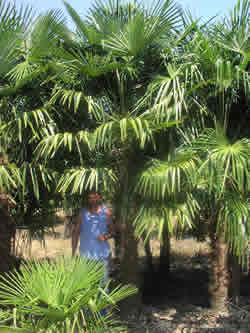
The Windmill Palm is the most widely planted cold-hardy palm in North Carolina and the species we most frequently recommend for Triangle landscapes. It is reliably cold-hardy to USDA Zone 7b — tolerating temperatures down to 5°F with proper siting — and has been successfully established across Raleigh, Durham, and Chapel Hill for many years. Mature specimens have survived multiple hard winters in the Triangle with no significant damage.
Windmill Palms reach 10 to 20 feet at maturity with a single, slender trunk topped by a dense crown of fan-shaped fronds. The trunk is covered in a distinctive fibrous, burlap-like material that provides natural insulation — one reason this species handles cold better than its Zone 7b rating alone suggests. Growth rate is slow to moderate, meaning that installing a specimen-sized Windmill Palm at 8 to 12 feet delivers immediate visual impact that small nursery stock cannot approach for many years.
Windmill Palms perform in full sun to partial shade, tolerate a range of soil conditions including the clay soils common to the Piedmont, and are exceptionally low-maintenance once established. They are the workhorse of cold-hardy palm installation in NC and the starting point for almost every palm consultation we conduct in the Triangle region.
Needle Palm (Rhapidophyllum hystrix) — The Hardiest Palm in North America
The Needle Palm is the most cold-hardy palm species in the world, rated to USDA Zone 6b and capable of surviving temperatures as low as −5°F in protected sites. Native to the southeastern United States, it is a clumping, trunkless palm that reaches 6 to 8 feet in height with a dense, spreading form. For Triangle homeowners who want absolute cold hardiness with no winter anxiety, the Needle Palm is the answer.
The trade-off is size and growth rate. Needle Palm grows very slowly — it can take many years to reach its modest mature height — and its clumping, shrubby form makes it more suitable as a bold accent plant or understory specimen than as a tall, architectural focal point. It performs in conditions ranging from full sun to full shade, which makes it versatile for sites where other palms would not be practical.
For poolside plantings, shaded garden beds, or any site where a low, dramatic, tropical-looking accent is desired without height or cold risk, Needle Palm is an outstanding choice.
Pindo Palm (Butia capitata) — Feathery Texture and Edible Fruit
The Pindo Palm, also called the Jelly Palm, is a single-trunk species with gracefully arching, blue-green feather fronds that give it a distinctly different look from the fan-palmed Windmill and Needle species. It reaches 15 to 20 feet at maturity and is rated to Zone 7b, making it suitable for most Triangle locations with appropriate siting.
Pindo Palm is slow-growing and performs best in full sun with good drainage — it is less tolerant of the wet clay conditions common to many Piedmont residential sites than Windmill or Needle Palm. Properly sited on a raised or well-drained area, it is a long-lived, low-maintenance specimen that produces clusters of orange fruit in summer (edible and sometimes used for jelly, which accounts for the common name).
The Pindo Palm’s feathery, arching frond structure makes it one of the most ornamentally distinctive palms available for NC landscapes and an outstanding specimen focal tree for pool surrounds, entries, and open lawn settings.
Needle Palm vs. Windmill Palm: Which Should You Choose?
The most common question we field about cold-hardy palms in North Carolina is which of these two species is the better choice. The answer depends entirely on your goals:
- Choose Windmill Palm if you want a tall, single-trunk architectural specimen — the classic palm silhouette — and your site receives at least partial sun.
- Choose Needle Palm if you want maximum cold hardiness, a bold low-growing accent, or a palm for a shaded or partially shaded location.
- Choose Pindo Palm if you want feathery arching fronds, a distinctive blue-green color, and are willing to ensure excellent drainage.
What Makes a Palm Installation Succeed in NC
Species selection is only part of the equation. The difference between a palm that thrives in the Triangle and one that struggles often comes down to siting and installation practice.
Microclimate Matters
Cold-hardy ratings reflect average conditions, not worst-case scenarios. A palm planted in a low-lying frost pocket or on a north-facing exposure with no wind protection faces a harder winter than the same species planted against a south-facing wall or in a sheltered courtyard. The best palm installations in the Triangle take advantage of microclimates — building walls, existing tree canopy, and topographic position — to buffer the plants against temperature extremes.
Drainage Is Non-Negotiable
All cold-hardy palms perform better in well-drained soil. In the Triangle’s heavy clay soils, this often means amending the planting area or slightly elevating the root zone before installation. A palm that sits in wet soil through the winter is far more vulnerable to cold damage than the same plant in a well-drained location — waterlogged roots reduce cold hardiness significantly. Proper soil preparation before installation is one of the most important predictors of long-term palm health in NC landscapes.
Specimen-Sized Plants Establish Better
Large, field-grown palms have more extensive root systems than container-grown nursery stock and are better equipped to handle the stress of transplanting and their first Triangle winter. We source and install Windmill Palms, Needle Palms, and Pindo Palms at mature heights specifically because larger specimens establish more reliably and deliver immediate visual impact — both of which matter when you are investing in a specimen plant.
|
A note on winter protection: Established, properly sited cold-hardy palms in the Triangle generally do not require winter wrapping. Newly installed palms in their first winter may benefit from light trunk wrapping during extreme cold events. We provide specific aftercare guidance with every palm installation. |
Palm Trees and Pool Landscapes
Cold-hardy palms are among the most requested plants for pool landscape installations in the Triangle region, and for good reason. A Windmill Palm or Pindo Palm framing a pool immediately elevates the setting — creating the resort aesthetic that most pool owners are aiming for without the maintenance demands of tropical plants that cannot survive NC winters.
Palms are also well-suited to poolside conditions. They do not drop excessive leaf litter into the water, their root systems are generally non-invasive compared to broad-canopy shade trees, and their upright form provides vertical structure without casting the heavy shade that makes pool areas feel closed in. For pool landscape design in the Triangle, cold-hardy palms are one of our most effective and most requested plant categories.
Schedule a Cold-Hardy Palm Consultation
Palm installation in North Carolina is more nuanced than most landscape work — species selection, microclimate assessment, soil preparation, and establishment care all require specific knowledge that general landscapers rarely bring to the table. Home & Garden Landscapes has been installing cold-hardy palms across the Triangle region since 2002, and our team holds advanced horticultural credentials from NC State University.
If you are interested in adding cold-hardy palms to your landscape — whether as a specimen focal plant, a pool surround feature, or a bold accent in a mixed planting — we offer free on-site consultations throughout the Raleigh, Durham, and Chapel Hill area.
Call 919-801-0211 to schedule your free consultation.