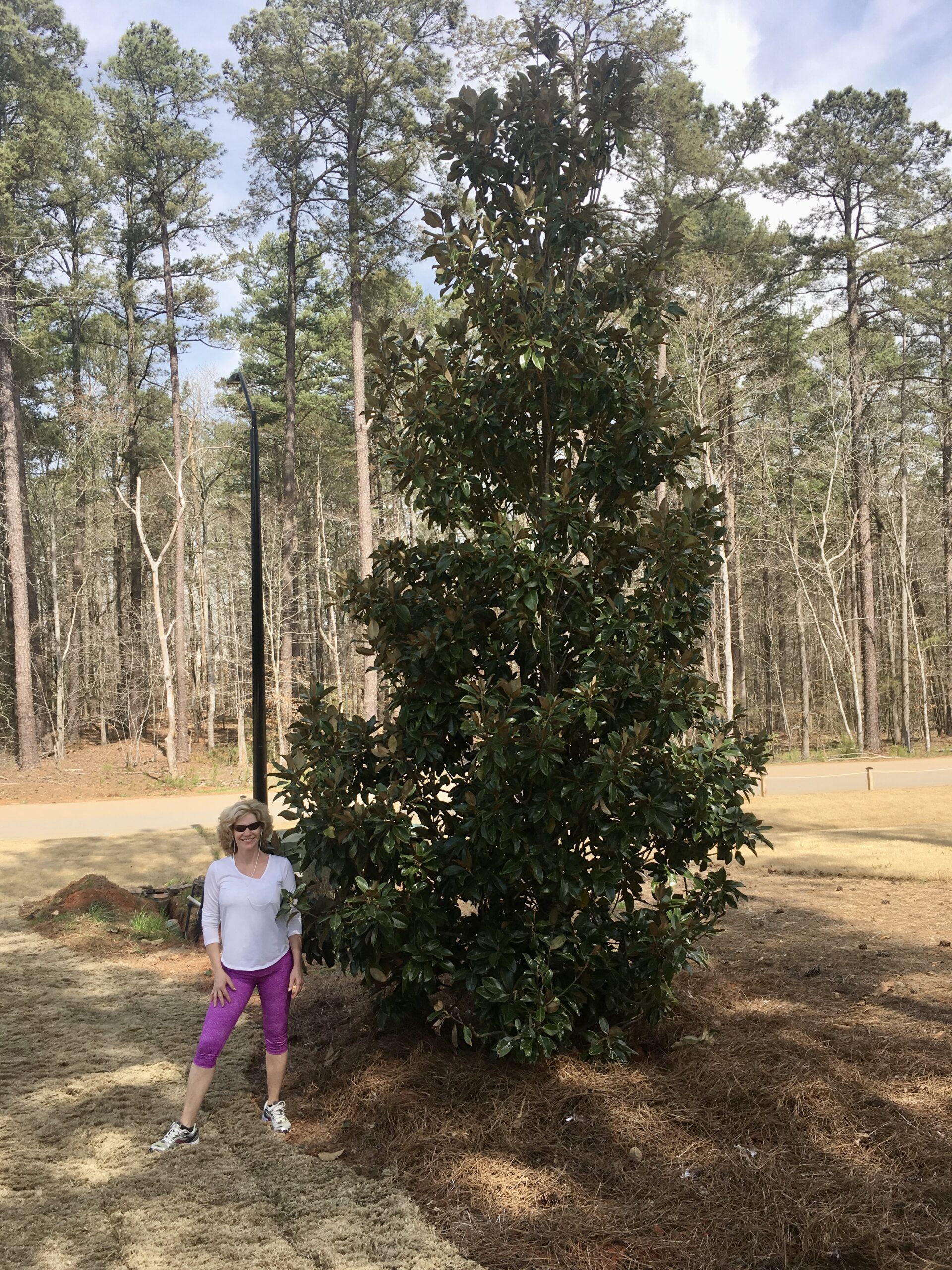
 The Southern magnolia (Magnolia grandiflora) is one of the most iconic trees in the American landscape — and one of the most commonly misunderstood when it comes to selection. Many homeowners think of Southern magnolia as a single, monolithic plant: the enormous, slow-growing tree that drops leathery leaves year-round and eventually crowds everything around it. That description fits the standard species form, but it misses the wide range of cultivars that have made Magnolia grandiflora one of the most versatile trees available for NC Piedmont landscapes.
Today’s Southern magnolia cultivars span an enormous range of sizes, growth rates, and forms — from compact 20-foot specimens suited to small urban yards to broad-canopy estate trees that mature at 60 to 80 feet. Choosing the right one requires understanding what distinguishes each cultivar and matching those characteristics to the specific conditions and goals of your landscape.
This guide covers the most widely installed Magnolia grandiflora cultivars in North Carolina, with specific data on size, growth rate, hardiness, and best uses — so you can make a confident selection rather than a costly mistake.
Why Cultivar Selection Matters More Than You Might Think
Planting the wrong magnolia cultivar for your space is one of the most common — and most expensive — landscaping mistakes in NC Piedmont yards. The standard species form of Magnolia grandiflora can reach 60 to 80 feet in height with a canopy spread of 30 to 40 feet. Planted in a typical suburban backyard or close to a structure, a standard-form magnolia will eventually outgrow its space, overwhelm adjacent plantings, lift hardscaping with its root system, and require aggressive management.
Compact and columnar cultivars solve this problem entirely. ‘Little Gem’ matures at 20 to 25 feet — less than a third the size of the standard form — with a tidy, dense habit that requires almost no pruning. ‘Alta’ grows tall but stays narrow, topping out at 45 to 50 feet with a spread of only 12 to 15 feet, making it suitable for tight lots or as a screening tree where space is limited.
The right cultivar installed at the right size in the right location is a permanent, low-maintenance landscape asset. The wrong cultivar becomes a liability within a decade.
Southern Magnolia Cultivar Comparison
|
Cultivar |
Mature Height |
Mature Width |
Growth Rate |
Best Use |
Zones |
|
‘Bracken’s Brown Beauty’ |
30–40 ft |
15–20 ft |
Moderate |
Residential screening, specimen tree |
5–9 |
|
‘DD Blanchard’ |
50–60 ft |
20–30 ft |
Moderate–Fast |
Large lots, street tree, specimen |
6–9 |
|
‘Alta’ |
45–50 ft |
12–15 ft |
Moderate–Fast |
Narrow lots, screening, urban plantings |
6–9 |
|
‘Claudia Wannamaker’ |
35–50 ft |
20–25 ft |
Fast |
Large-scale screening, estate plantings |
6–9 |
|
‘Kay Parris’ |
25–30 ft |
15 ft |
Moderate |
Residential yards, early flowering |
6–9 |
|
Standard (species form) |
60–80 ft |
30–40 ft |
Moderate |
Estate, historic, large-scale specimen |
6–10 |
|
‘Little Gem’ |
20–25 ft |
10–12 ft |
Slow |
Small yards, tight spaces, containers |
7–9 |
Cultivar Profiles
‘Little Gem’ — Best for Small Yards and Tight Spaces
‘Little Gem’ is the most widely planted compact Southern magnolia in North Carolina, and for good reason. It reaches 20 to 25 feet at maturity with a narrow, columnar form and a spread of only 10 to 12 feet — making it suitable for spaces where a standard magnolia would be impossible. The foliage is exceptionally dense, with the characteristic glossy upper surface and rich brown underside of Magnolia grandiflora, and ‘Little Gem’ blooms more prolifically and over a longer season than most other cultivars, producing fragrant white flowers from late spring through summer.
Growth rate is slow to moderate, which has two practical implications: ‘Little Gem’ holds its shape well without pruning, and installing a specimen-sized plant at 8 to 12 feet delivers immediate visual impact that small nursery stock cannot match for many years. Hardy in Zones 7 through 9, it is well-adapted to the NC Piedmont’s climate and tolerates the region’s clay soils.
Best uses: foundation plantings, courtyard specimens, narrow side yards, residential screening, container planting in large pots for patios and entries.
‘Bracken’s Brown Beauty’ — Best for Cold Hardiness and Residential Scale
‘Bracken’s Brown Beauty’ is one of the hardiest Magnolia grandiflora cultivars available, rated to USDA Zone 5 — which means it handles the coldest winters the NC Piedmont will produce without any concern. It reaches 30 to 40 feet at maturity with a moderate spread of 15 to 20 feet, making it well-suited to residential lots where a full-size magnolia would be too large but ‘Little Gem’ would be too small.
The cultivar is named for the distinctive brown indumentum — the velvety coating — on the undersides of its leaves, which is among the most pronounced of any Magnolia grandiflora selection. Growth rate is moderate, and the form is naturally dense and pyramidal with minimal pruning required. ‘Bracken’s Brown Beauty’ is a reliable, handsome tree at residential scale and one of our most frequently installed magnolia cultivars across the Triangle region.
Best uses: residential specimen tree, background screening, privacy planting at moderate scale, foundation anchor for large homes.
‘DD Blanchard’ — Best for Large Properties and Maximum Presence
‘DD Blanchard’ is a large-form cultivar that reaches 50 to 60 feet at maturity with a broad, dense canopy — one of the most stately of the named Magnolia grandiflora selections. It grows at a moderate to fast rate and produces large, glossy leaves with a deep orange-brown indumentum that is particularly ornamental. The overall effect is bold and commanding in the landscape.
Because of its ultimate size, ‘DD Blanchard’ is best suited to large residential lots, estate properties, and commercial landscapes where there is room for the canopy to develop fully. It is not the right choice for small or medium suburban yards. But for a property that can accommodate it, a specimen ‘DD Blanchard’ installed at 12 to 15 feet is among the most impressive ornamental trees we install in the Triangle region. Hardy in Zones 6 through 9.
Best uses: large residential lots, estate specimens, street tree applications, large-scale privacy and windbreak plantings.
‘Alta’ — Best for Narrow Lots and Columnar Screening
‘Alta’ is an underutilized cultivar that deserves far more attention in NC Piedmont landscapes. It grows tall — 45 to 50 feet at maturity — but maintains an unusually narrow spread of only 12 to 15 feet, giving it a columnar profile that is nearly unique among large evergreen trees. This combination of height and narrow form makes ‘Alta’ an outstanding choice for screening applications where vertical coverage is needed but lot width is limited.
Hardy in Zones 6 through 9, ‘Alta’ grows at a moderate to fast rate and holds its columnar form naturally without pruning. For new construction lots with tight side yards, boundary screening along narrow corridors, or urban residential applications where space constraints rule out most large trees, ‘Alta’ offers a solution that no other Magnolia grandiflora cultivar can match.
Best uses: narrow side yards, columnar screening and privacy hedges, urban street plantings, tight lot lines where vertical impact is needed.
‘Claudia Wannamaker’ — Best for Fast, Large-Scale Coverage
‘Claudia Wannamaker’ is one of the fastest-growing Magnolia grandiflora cultivars available, with a growth rate that outpaces most other selections in the species. It reaches 35 to 50 feet at maturity with a broad, dense canopy — and it gets there faster than cultivars like ‘Bracken’s Brown Beauty’ or ‘Little Gem.’ This makes it a strong choice for homeowners who need large-scale screening or canopy coverage in a shorter timeframe.
Hardy in Zones 6 through 9, ‘Claudia Wannamaker’ is well-adapted to the NC Piedmont and tolerates a range of soil conditions. Its combination of fast growth, substantial mature size, and attractive foliage makes it a workhorse cultivar for estate-scale and large residential landscape projects. It is not suited to small or medium yards.
Best uses: large-scale screening, estate plantings, fast canopy establishment, background tree for large landscape compositions.
‘Kay Parris’ — Best for Early Flowering and Residential Yards
‘Kay Parris’ is a compact to medium cultivar that matures at 25 to 30 feet with a spread of approximately 15 feet — making it a practical choice for residential yards where ‘Little Gem’ is too small and ‘Bracken’s Brown Beauty’ may be slightly large. It is notable for beginning to flower at a young age, often blooming in its first or second year after installation, whereas some magnolia cultivars require several years of establishment before producing flowers.
The foliage of ‘Kay Parris’ has a finer texture than many other cultivars, and the tree maintains a tidy, compact form with minimal pruning. Hardy in Zones 6 through 9. For homeowners who want a magnolia that looks finished and begins flowering quickly, ‘Kay Parris’ is one of the best-performing options at residential scale.
Best uses: residential specimen tree, mixed border anchor, smaller estate applications, any site where early flowering is a priority.
Which Magnolia Cultivar Is Right for Your Yard?
The single most important question is ultimate size. Before selecting a cultivar, identify the actual space available — not the space that looks available today, but the space the tree will need at 20 and 40 years. A ‘Little Gem’ installed in a 12-foot-wide side yard is a long-term asset. A ‘DD Blanchard’ installed in the same space is a long-term problem.
Beyond size, the key selection factors for NC Piedmont landscapes are:
- Sun exposure — all Magnolia grandiflora cultivars prefer full sun to light partial shade; deep shade suppresses flowering and reduces density
- Proximity to structures — columnar forms like ‘Alta’ and compact forms like ‘Little Gem’ are the only cultivars appropriate within 15 feet of a building or hardscape
- Screening vs. specimen use — large cultivars like ‘Claudia Wannamaker’ and ‘DD Blanchard’ are effective as background screening plants; compact cultivars are better as focal specimens
- Cold hardiness — all cultivars listed above are reliably hardy in Zone 7b; ‘Bracken’s Brown Beauty’ is the best choice for sites with unusual cold exposure
- Installed size — for immediate visual impact, specimen-grade plants installed at 8 to 20 feet deliver results that small nursery stock cannot match for many years
Installing Southern Magnolias at Specimen Size
Home & Garden Landscapes sources and installs Southern magnolia cultivars at heights from 8 to 20 feet, depending on species availability and project requirements. Installing a magnolia at specimen size — rather than from a small nursery container — compresses years of establishment time into a single day and delivers a landscape that looks finished from the moment the crew leaves.
We carry multiple Magnolia grandiflora cultivars in our plant catalog and can provide specific availability and sizing information during a site consultation. Cultivar selection, placement, soil preparation, and post-installation care are all part of every magnolia installation we complete across the Triangle region.
Call 919-801-0211 to schedule your free consultation.