The Best Privacy Trees for North Carolina Zone 7b
 If you are searching for privacy trees for a property in Raleigh, Durham, Chapel Hill, or anywhere in North Carolina’s Piedmont, you are gardening in USDA Hardiness Zone 7b — a zone defined by average annual minimum temperatures of 5°F to 10°F. That single number has significant implications for which privacy trees will perform reliably and which ones will struggle or fail.
Zone 7b is a demanding climate for screening plants. Summers are hot and humid, with extended drought pressure that stresses shallowly rooted trees. Winters bring occasional hard freezes that can damage cold-sensitive species. And the region’s heavy clay soils, while fertile, drain slowly and suffocate roots during wet periods. The best privacy trees for North Carolina’s Zone 7b are plants that have evolved to handle all of these conditions — not just one or two.
Below is a guide to the top-performing privacy screening plants for the Triangle region, based on decades of installation and observation in NC Piedmont landscapes.
What Makes a Good Privacy Tree for Zone 7b?
Before getting into specific plants, it helps to understand what separates a reliable privacy tree from one that looks good at the nursery but underperforms in the landscape. For Zone 7b, the key criteria are:
- Cold hardiness to at least Zone 7 (tolerates minimum temperatures of 0°F to 10°F)
- Heat and humidity tolerance — the ability to thrive through NC’s long, hot summers
- Adaptability to clay soil and periodic drought
- Dense, year-round evergreen foliage for continuous screening
- Resistance to the major pests and diseases common in the Southeast
- A mature height appropriate to the screening need (typically 15 feet or taller)
Deer resistance is also a significant practical consideration in the Triangle region, where residential deer pressure has increased substantially over the past two decades.
The Top Privacy Trees for NC Zone 7b
|
Plant |
Height |
Sun / Shade |
Growth Rate |
Zones |
Deer Res. |
|
Emily Bruner Holly |
20–25 ft |
Full sun to full shade |
Moderate |
6–9 |
Yes |
|
Nellie Stevens Holly |
15–25 ft |
Full sun to part shade |
Fast |
6–9 |
Yes |
|
Green Giant Arborvitae |
40–60 ft |
Full sun to part shade |
3–5 ft/year |
5–9 |
Moderate |
|
Cryptomeria japonica |
30–40 ft |
Full sun to part shade |
2–3 ft/year |
5–9 |
Moderate |
|
Southern Magnolia |
60–80 ft |
Full sun to part shade |
Moderate |
6–10 |
Yes |
|
Leyland Cypress* |
60–70 ft |
Full sun |
3–4 ft/year |
6–10 |
No |
* Leyland cypress included for reference. Not recommended due to widespread disease susceptibility in NC.
Emily Bruner Holly (Ilex × ‘Emily Bruner’)
Emily Bruner Holly is the top-recommended privacy screening plant for North Carolina landscapes, and the single best option for shaded or partially shaded sites. It is hardy in USDA Zones 6 through 9 — well within Zone 7b’s range — and performs reliably in conditions spanning from full sun to full shade, a versatility that no conifer can match.
At maturity, Emily Bruner Holly reaches 20 to 25 feet in height with a dense, broadly pyramidal form. Growth rate is moderate, meaning that installed specimens hold their shape and density without the aggressive pruning requirements of faster-growing plants. The foliage is deep, lustrous green year-round, with abundant red berries in winter that persist through the season and provide significant wildlife value.
Emily Bruner Holly is deer resistant, tolerates the clay soils common across the NC Piedmont, and shows no susceptibility to Seiridium canker, Botryosphaeria dieback, or the other pathogens that have devastated Leyland cypress hedges across the region. It is the preferred choice for screening along wooded property lines, north-facing exposures, and any site where reliable performance in shade is required.
Nellie Stevens Holly (Ilex × ‘Nellie R. Stevens’)
Nellie Stevens Holly is a fast-growing, densely branched evergreen holly that reaches 15 to 25 feet at maturity and performs well in full sun to partial shade. It is one of the most widely planted screening hollies in the Southeast, favored for its rapid establishment, consistent form, and low maintenance requirements once in the ground.
Hardy in Zones 6 through 9, Nellie Stevens Holly handles Zone 7b winters without difficulty and is well-adapted to the summer heat and clay soils of the NC Piedmont. The foliage is glossy, dark green, and exceptionally dense — providing solid year-round screening from installation. Like Emily Bruner, it is deer resistant and disease resistant.
Nellie Stevens Holly is the most common recommendation for sunny exposures — south and west-facing property lines, pool surrounds, and road-facing hedges where maximum light is available. For properties that need both sun and shade screening, a combination of Nellie Stevens in the sun and Emily Bruner in the shade provides seamless coverage across varying conditions.
Green Giant Arborvitae (Thuja plicata ‘Green Giant’)
Green Giant Arborvitae is the best conifer option for Zone 7b privacy screening and the closest available substitute for homeowners who want the tall, narrow, fast-growing form of a Leyland cypress without the disease problems. It can grow 3 to 5 feet per year in ideal conditions and reaches 40 to 60 feet at maturity — among the fastest and tallest of any privacy tree available in the region.
Hardy in Zones 5 through 9, Green Giant Arborvitae is significantly more disease-resistant than Leyland cypress and is not susceptible to Seiridium canker or Botryosphaeria dieback. It performs best in full sun to partial shade and tolerates a range of soil conditions, including the moderately wet clay soils common to the Piedmont. For large properties where rapid height and maximum eventual screening coverage are the priority, Green Giant is the most effective option available.
One important note: Green Giant Arborvitae offers only moderate deer resistance and may require protective measures in areas with high deer pressure.
Cryptomeria japonica
Cryptomeria japonica brings a refined texture and visual character to privacy screening that distinguishes it from the more utilitarian appearance of arborvitae or the bold glossiness of holly. The foliage is soft and feathery, the form is gracefully irregular at maturity, and the overall effect in the landscape is considerably more elegant than a standard conifer hedge.
Cryptomeria reaches 30 to 40 feet at maturity with a growth rate of 2 to 3 feet per year — fast enough to establish meaningful screening within a few seasons when planted at nursery size, or immediately when installed as a specimen-grade plant. It is hardy in Zones 5 through 9, performs well across the full range of Zone 7b conditions, and is far less susceptible to the disease and pest pressure that affects Leyland cypress.
Cryptomeria is an excellent choice for homeowners who want screening with genuine aesthetic appeal — particularly in landscapes where the privacy hedge is visible from living areas and needs to contribute positively to the overall design.
Southern Magnolia (Magnolia grandiflora)
Southern Magnolia is the most iconic large evergreen tree of the American South, and it is an underutilized privacy screening option in Zone 7b landscapes. At maturity, Magnolia grandiflora can reach 60 to 80 feet in height with a broad, dense canopy — making it one of the most effective large-scale privacy trees available in the region.
Multiple cultivars are available with varying size and form characteristics. Compact or columnar cultivars such as ‘Little Gem,’ ‘Bracken’s Brown Beauty,’ and ‘DD Blanchard’ offer more controlled growth habits suitable for residential screening applications, while standard-form specimens are appropriate for large-scale installations where maximum height and canopy mass are desired.
Southern Magnolia is fully hardy in Zone 7b, deer resistant, and highly drought tolerant once established. Installed at 8 to 20 feet in height, specimen magnolias provide immediate visual presence and screening while maturing into permanent landscape features that add significant property value.
What About Leyland Cypress?
Leyland cypress is included in the comparison table above for reference because it remains widely recognized as a privacy tree — and many homeowners in the Triangle region are actively searching for information about it, often because their existing hedge is failing.
We do not recommend Leyland cypress for new privacy screen installations in North Carolina. Seiridium canker and Botryosphaeria dieback have devastated established hedges across the region, and newly planted Leyland cypress faces the same disease pressure as the trees that are currently failing. The four alternatives above — Emily Bruner Holly, Nellie Stevens Holly, Green Giant Arborvitae, and Cryptomeria — all provide equal or superior screening without the vulnerability that has made Leyland cypress a costly problem for thousands of NC homeowners.
Does Planting Size Matter?
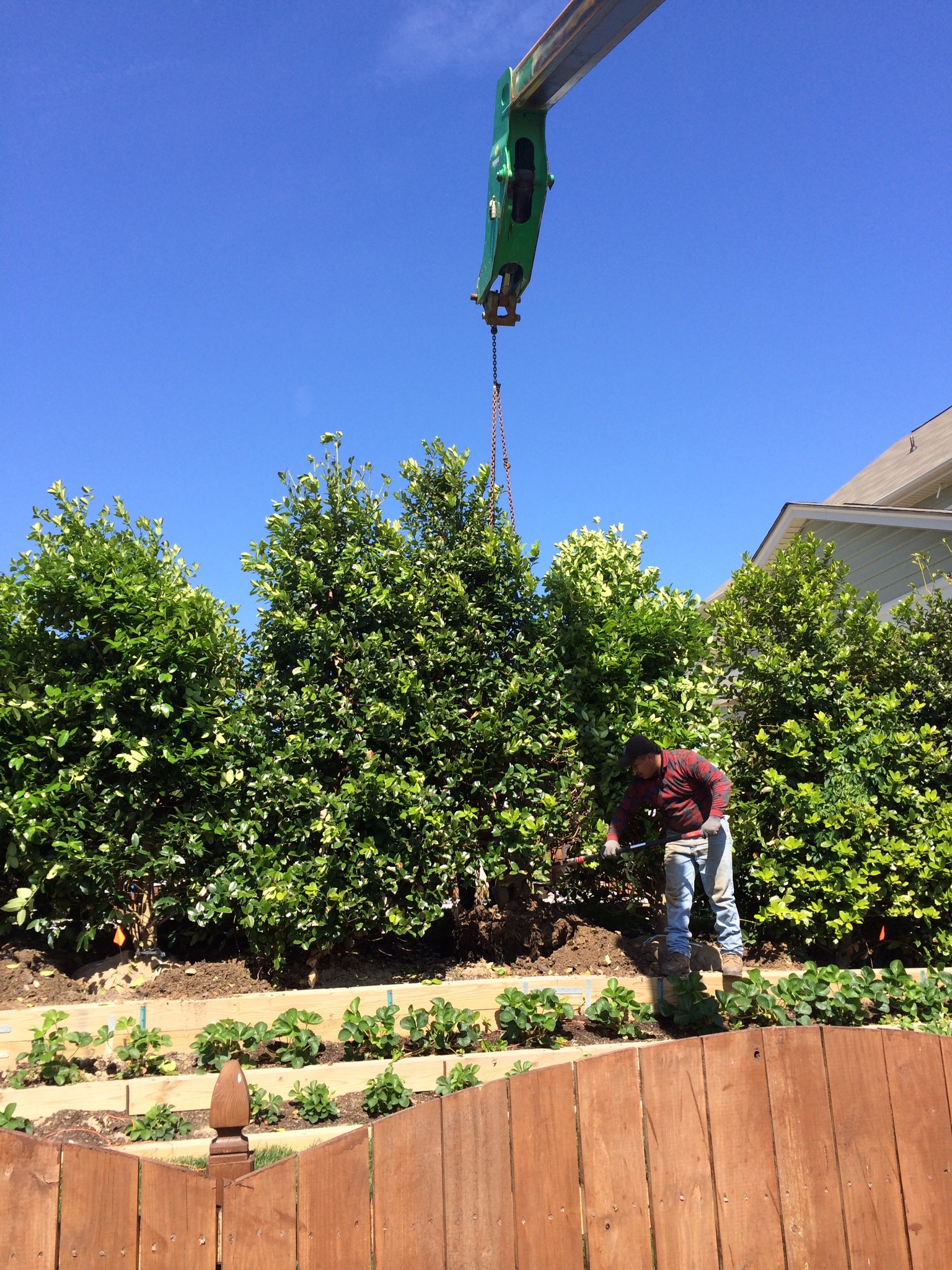
Significantly. Nursery-grade screening plants in 3- or 5-gallon containers are inexpensive, but they will take five to eight years to reach meaningful screening height under typical Zone 7b growing conditions. For homeowners who need privacy now — not in a decade — specimen-grade plants installed at 8 to 15 feet in height are the only way to achieve immediate results.
At Home & Garden Landscapes, we specialize in sourcing and installing mature, specimen-grade privacy plants across the Raleigh, Durham, and Chapel Hill area. When we install a privacy screen, it is a finished, functioning screen on the day our crew leaves your property — not a planting plan for the next decade.
Schedule a Free Privacy Screening Consultation
Every privacy screening project is different. The right plant depends on your sun and shade conditions, soil, spacing constraints, deer pressure, desired height, and the specific views you need to block. We offer free on-site consultations across the Triangle region to assess your property and recommend the right solution for your specific situation.
Call 919-801-0211 to schedule your free consultation.
NC Licensed Landscape Contractor · NCLC #2591 · homeandgardenlandscapes.com