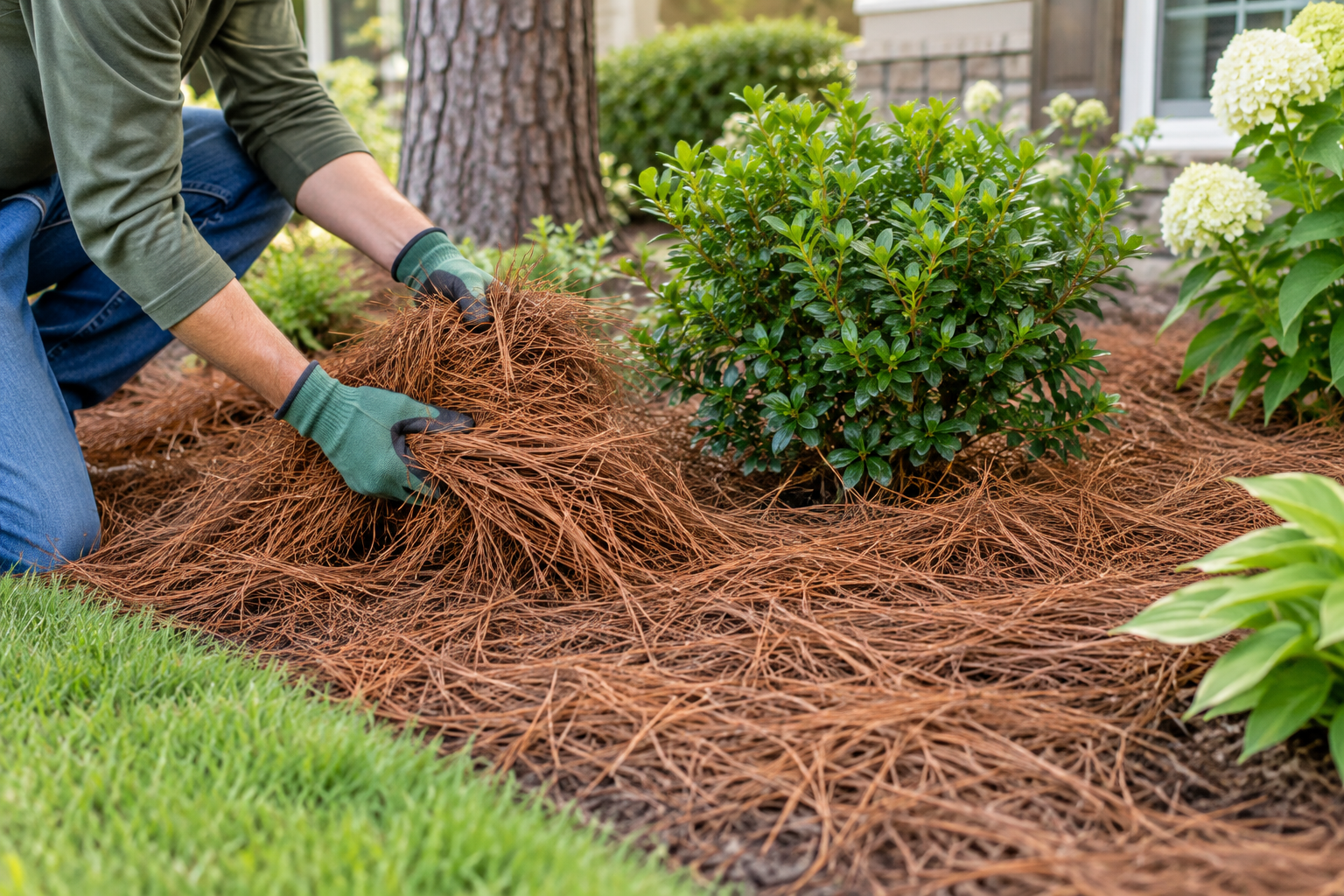
 Mulching is the single most impactful routine maintenance practice available for NC Piedmont landscapes — and one of the most frequently done wrong. Applied correctly, organic mulch suppresses weeds, moderates soil temperature, retains moisture through summer drought, and improves the clay soil structure that defines most Triangle-area residential lots. Applied incorrectly — too deep, against the trunk, or from the wrong material — it actively harms the plants it is supposed to protect.
This guide covers the mulch types that work best in the Triangle region’s climate and soils, the correct depth and placement for every application, and the specific mistakes — including the one that kills more trees in suburban NC than almost any other common practice — that homeowners and even some landscapers make every season.
Why Mulch Matters More in the NC Piedmont
The heavy clay soils characteristic of the Triangle region create a specific set of conditions that make organic mulch particularly valuable. Clay soil holds moisture well but drains slowly — creating wet conditions in spring that can suffocate roots, and then compacting to near-brick hardness during the summer drought periods that are a reliable feature of NC Piedmont summers. Organic mulch moderates both extremes: it reduces evaporation from the soil surface during drought and absorbs rainfall that might otherwise pond on clay, releasing it more gradually.
As organic mulch decomposes, it contributes organic matter to the soil surface — improving the clay’s structure, drainage, and the biological activity that supports root health. In a heavy clay soil environment, this organic matter contribution is not a bonus feature of mulching; it is one of the primary long-term benefits that distinguishes mulched beds from bare soil over multiple years.
The other factor that makes mulching particularly important in the Triangle is the region’s summer heat intensity. Soil temperatures in unmulched beds in a Raleigh-area summer regularly exceed 90°F at shallow depths — temperatures that stress feeder roots and inhibit the soil biology that plants depend on. A 3-to-4-inch layer of organic mulch reduces soil surface temperature significantly, keeping the root zone meaningfully cooler through July and August.
Mulch Type Comparison for NC Piedmont
|
Mulch Type |
Depth |
Soil Benefit |
Longevity |
Best Use |
Avoid When |
|
Double-ground hardwood bark |
3–4 in. |
Excellent — improves structure as it breaks down |
1–2 years |
Tree and shrub beds, general landscape use |
— |
|
Pine bark mini nuggets |
3 in. |
Good — acidifies soil slightly as it decomposes |
2–3 years |
Acid-loving plants: azaleas, hollies, camellias |
Slopes — nuggets can float |
|
Pine straw (pine needles) |
3–4 in. |
Moderate — slow decomposition, mild acidification |
1 year |
Sloped beds, naturalistic settings, acid-loving plants |
Formal beds — less polished appearance |
|
Wood chip mulch (arborist chips) |
4–6 in. |
Excellent — long-term soil biology improvement |
2–4 years |
Under trees, naturalistic areas, large beds |
Formal foundation beds — coarse appearance |
|
Rubber/dyed mulch |
N/A |
None — does not decompose |
Many years |
Playground surfaces |
Any planting bed — no soil benefit, may leach chemicals |
The Best Mulch Types for Triangle Landscapes
Double-Ground Hardwood Bark — The Workhorse Choice
Double-ground hardwood bark is the most versatile and most widely used mulch for NC Piedmont landscapes, and it is the default recommendation for most foundation beds, mixed borders, and tree rings. The double-grinding process produces a uniform, fine-textured product that knits together well, resists displacement in rain and wind, and breaks down into organic matter at a rate that meaningfully improves clay soil over multiple seasons.
Applied at 3 to 4 inches, double-ground hardwood bark provides excellent weed suppression and moisture retention and lasts one to two years before needing replenishment. The natural brown color is neutral and complements most landscape plantings without the artificial look of dyed products.
Pine Bark Mini Nuggets — Best for Acid-Loving Plants
Pine bark mulch in mini nugget form is the preferred choice around acid-loving plants — hollies, azaleas, camellias, blueberries, and rhododendrons — that prefer soil pH in the 5.0 to 6.5 range. As pine bark decomposes, it releases organic acids that maintain slightly acidic conditions at the root zone, reinforcing the soil chemistry these plants prefer.
Mini nuggets are more stable on slopes than finer-textured hardwood bark and last longer — typically two to three years before significant replenishment is needed. The coarser texture makes them less suitable for formal foundation beds where a tidy, polished appearance is desired.
Pine Straw — Best for Slopes and Naturalistic Settings
Pine straw (dried pine needles) is a traditional southern mulch that works particularly well on sloped beds where bark mulch may wash during heavy rains. It knits together as it settles, forming a mat that resists displacement even on moderate grades. It decomposes within about a year and requires annual replacement — more frequent than bark mulch.
Pine straw provides mild acidification as it breaks down, making it suitable for hollies and other acid-preferring plants. It is a good choice for naturalistic plantings and woodland garden settings where its informal texture complements the surroundings. For formal foundation beds and high-visibility areas, double-ground hardwood bark presents more cleanly.
Arborist Wood Chips — Best for Under-Tree Applications
Coarse arborist wood chips — the material produced when tree service companies chip branches and small-diameter wood — are one of the most beneficial mulches available for use under trees and in large naturalistic beds. Applied at 4 to 6 inches deep, wood chips decompose slowly and dramatically improve the biological activity and organic matter content of soil over multiple years. Research from horticulturists including Dr. Linda Chalker-Scott at Washington State University has documented significant tree health improvements in wood-chip-mulched zones versus bare or bark-mulched root zones.
Wood chips are coarser and less visually refined than processed bark mulch, making them less appropriate for formal foundation beds or high-visibility landscape areas. Under trees, along wooded borders, and in large naturalistic bed areas, they are the highest-value mulch available for long-term soil improvement.
What to Avoid: Rubber and Dyed Mulches
Rubber mulch — made from recycled tires — should not be used in any planting bed. It provides zero soil benefit, does not decompose, and can leach zinc and other compounds into the soil that may harm plants and soil organisms. Dyed mulches use colorants — often containing chromated copper arsenate — that fade within a growing season, leaving beds with a faded, artificial appearance, and may inhibit beneficial soil biology.
The visual appeal of intensely colored dyed mulch is temporary; the functional advantage of organic mulch over rubber or dyed alternatives is permanent. For any application where plants are involved, organic mulch is the only appropriate choice.
The Most Critical Application Rule: Correct Depth
Mulch depth is where most application errors occur — and where the most plant damage originates. The correct depth for organic mulch is 3 to 4 inches from the soil surface. This provides adequate weed suppression and moisture retention without exceeding the thickness at which oxygen exchange at the soil surface becomes impaired.
- Too shallow (under 2 inches): Inadequate weed suppression; moisture loss too rapid in summer heat; minimal soil temperature benefit
- Correct depth (3 to 4 inches): Full weed suppression, moisture retention, and temperature moderation without root suffocation
- Too deep (over 4 to 5 inches): Reduces oxygen at soil surface; promotes anaerobic conditions that encourage root rot and fungal pathogens; can prevent rainfall from reaching root zone effectively
The depth error that accumulates most insidiously is repeated application without removing or disturbing previous layers. Homeowners who apply 3 inches of fresh mulch every year without assessing existing depth can build up 8, 10, or 12 inches of material over several seasons — far beyond the safe threshold — without realizing it.
The Most Damaging Common Mistake: Volcano Mulching
Volcano mulching — piling mulch in a cone against the base of a tree trunk — is the single most widespread and damaging mulching practice in American residential landscapes. It is visible in virtually every subdivision in the Triangle region and is responsible for the decline and death of many landscape trees that would otherwise have lived for decades.
The problem is moisture. A tree’s trunk bark is not designed to remain constantly moist. When mulch is piled against it, the bark stays wet, creating ideal conditions for fungal pathogens, crown rot, and insect pests that attack stressed tissue at the base of the tree. Over time, volcano mulching can cause girdling root growth, bark decay at the root flare, and cambium death — all of which undermine the vascular system that keeps the tree alive.
|
The correct technique: Apply mulch in a flat layer, keeping it 2 to 3 inches away from the trunk flare — the widened base where the trunk meets the soil. The trunk flare should be visible above the mulch surface at all times. If the trunk appears to go straight into the ground without flaring, the mulch is too deep or has been applied against the bark. |
Mulching Newly Installed Specimen Trees and Shrubs
Mulching is especially important for newly installed plants during the critical establishment period, when root systems are reestablishing and the plant’s ability to manage soil moisture and temperature stress is most limited. For any specimen tree or screening plant installed by Home & Garden Landscapes, mulch application is a standard part of the installation scope — not an optional add-on — because the establishment outcomes are directly affected by whether it is done correctly.
For newly installed specimen trees, extend the mulch ring to the drip line — the outer edge of the canopy — rather than applying a narrow ring around the trunk only. The feeder roots that support establishment extend outward to the canopy edge, and the entire root zone benefits from moisture conservation and temperature moderation during the first summer.
How Often to Remulch in the Triangle Region
In the Triangle’s warm, humid climate, double-ground hardwood bark typically requires replenishment every one to two years as it decomposes. Pine bark nuggets last two to three years. Pine straw needs annual replacement in most applications. The practical indicator for replenishment is when the mulch layer has thinned below 2 inches — at which point weed suppression and moisture retention become inadequate.
Spring is the traditional time for mulch replenishment in the Triangle — before summer heat and drought begin and while soil moisture from spring rains is present. Fall is also an appropriate window and has the advantage of insulating root zones before winter temperature extremes. Avoid applying fresh mulch directly on top of a substantial existing layer without checking total depth; the combination may exceed safe limits.
Ready to Discuss Your Landscape Maintenance?
Home & Garden Landscapes offers landscape installation and maintenance consultations across the Raleigh, Durham, Chapel Hill, and greater Triangle region. Correct mulching is part of every installation scope we complete — because the long-term performance of the plants we install depends as much on what happens in the months after installation as on what we do on installation day.
Call 919-801-0211 to schedule a consultation.