When a Triangle-area homeowner decides they need more privacy — whether from a new neighbor, a road, a pool exposure, or simply the density of a newer subdivision — the first question is almost always: fence or plants?
Both accomplish the same basic goal. Both have real advantages. And both have limitations that are easy to overlook when you are focused on solving the problem in front of you.
This is an honest comparison. We are a landscaping company, so we obviously believe in the value of privacy plantings — but we also know that a fence is sometimes the right answer, and we would rather help you make a well-informed decision than push you toward plants in a situation where a fence would serve you better.
What follows is the unvarnished comparison of both approaches across every factor that matters for a Triangle-area property.
The Direct Comparison
|
Factor |
Privacy Fence |
Privacy Plants |
|
Time to full privacy |
Immediate (day of installation) |
Immediate with specimen-grade plants; 5–8 years with nursery stock |
|
Upfront cost |
$30–$65+ per linear foot installed |
Varies by species and size; specimen-grade $100–$250 per vertical foot of coverage |
|
Ongoing maintenance |
Staining, painting, board replacement, post repair |
Minimal once established; no annual painting or repairs; consistent watering important for the first 3 years |
|
Maximum height |
6–8 ft (most HOAs and codes) |
15–40+ ft depending on species |
|
Lifespan |
15–25 years (wood); 30–50 years (vinyl/metal) |
Indefinite — improves with age |
|
Property value impact |
Neutral to modest positive |
Positive — mature plantings add measurable value |
|
HOA restrictions |
Common — many HOAs limit style, height, or prohibit entirely |
Rarely restricted; plants generally permitted |
|
Aesthetic character |
Hard edge; defines boundary visually |
Soft, natural; enhances rather than defines |
|
Noise reduction |
Minimal |
Meaningful — dense plantings absorb sound |
|
Wind buffering |
Deflects wind — can create turbulence |
Absorbs wind — more effective buffer |
Where Fences Win
Immediate Privacy at Lower Upfront Cost (With Small Plants)
If the comparison is a privacy fence versus nursery-grade screening plants at 3 to 5 feet tall, the fence wins on speed decisively. A fence installed this week provides immediate privacy. Nursery-grade hollies or arborvitae will take five to eight years to reach the same visual coverage. Fences are good, however, for containment of pets. For homeowners on a tight budget who need privacy now, a fence is the pragmatic short-term solution.
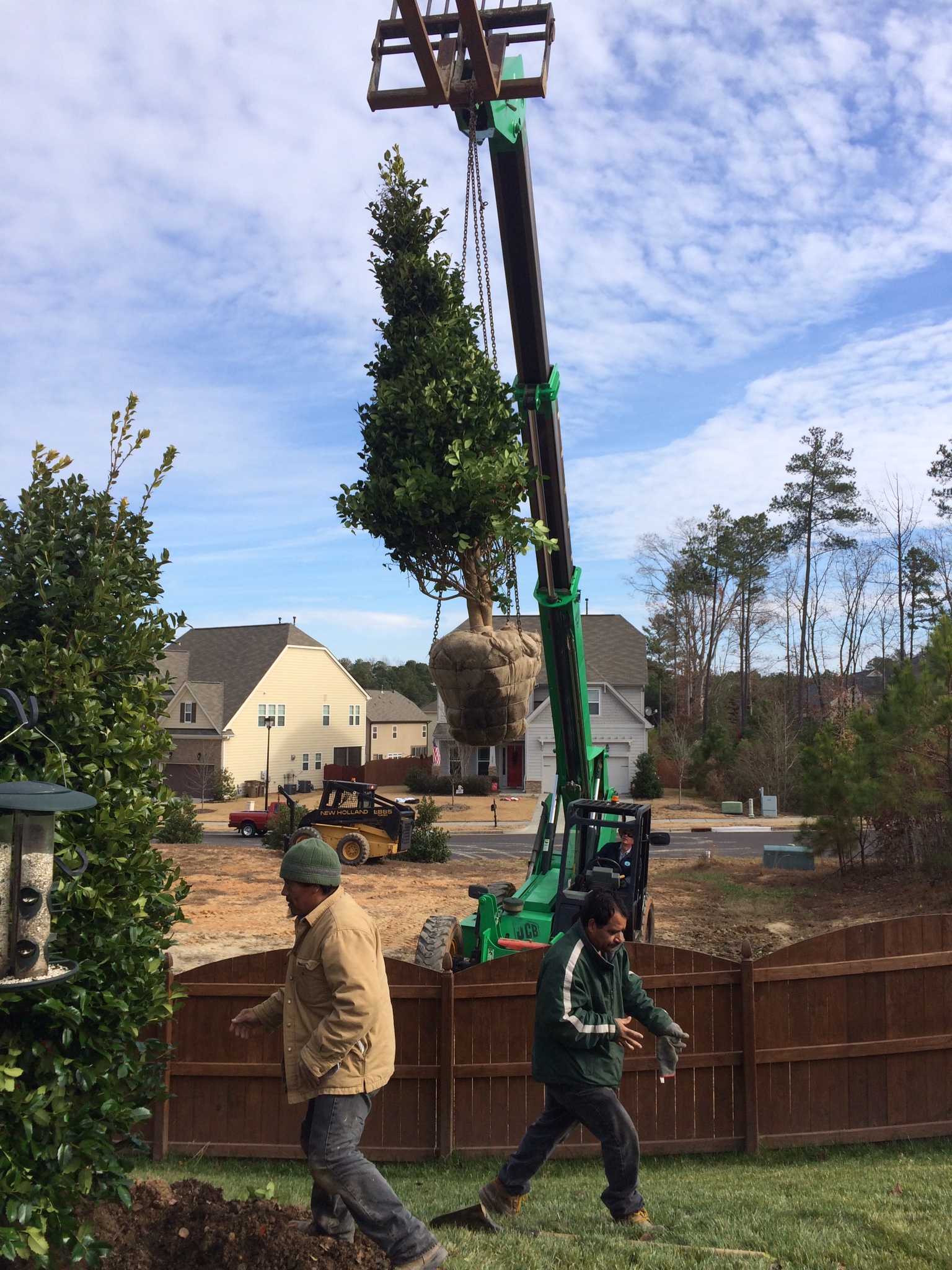
The calculation shifts considerably when the comparison is fence versus specimen-grade plants installed at 8 to 12 feet. At that scale, mature specimen hollies provide immediate screening comparable to a fence — and the cost differential narrows significantly when you factor in fence maintenance over the same timeframe.
Defined Property Boundary
A fence has one advantage no plant screen can match: it is an unambiguous, legally visible property boundary marker. In situations where a clear delineation between properties is desired — particularly between neighbors with an ambiguous or contested boundary — a fence accomplishes something a plant screen cannot. Plants grow and shift over time; a fence is a fixed line.
Zero Establishment Period
A fence does not need to establish. It does not require watering through its first summer, it is not vulnerable to drought stress or deer browse during establishment, and it does not have a window of vulnerability between installation and full function. For rental properties, commercial sites, or situations where post-installation care cannot be guaranteed, a fence eliminates the establishment risk entirely.
Where Privacy Plants Win
No Height Ceiling
This is the most decisive practical advantage of privacy plants in most Triangle neighborhoods. North Carolina municipalities and most HOAs cap fence height at 6 to 8 feet — enough to block ground-level views but not enough to screen second-story windows, elevated decks, or adjacent two-story homes. Emily Bruner Holly reaches 20 to 25 feet. Cryptomeria reaches 20 to 30 feet. Green Giant Arborvitae can reach 20 to 40 feet. No fence can compete with this scale, and for many Triangle properties — particularly those with two-story neighbors or elevated exposure — fence height simply is not enough.
HOA Environments
Many Triangle HOAs restrict or prohibit privacy fences entirely — requiring specific styles, limiting heights below what is useful, or banning solid-panel fencing altogether. Privacy plantings are almost never restricted in the same way. If your HOA governs what you can build but not what you can plant, a living screen is not just the better choice — it may be the only choice.
Long-Term Value and Longevity
A wood privacy fence has a practical lifespan of 15 to 25 years before boards rot, posts fail, or the structure requires significant repair or replacement. A vinyl fence lasts longer but requires investment in a product that adds no ecological or aesthetic value to the property. A mature planting of Emily Bruner holly or cryptomeria, properly installed and established, is a permanent asset that improves with every passing year — denser, taller, and more valuable as a property feature as it matures.
Multiple studies have documented the positive effect of mature landscaping on residential property values, with the National Association of Realtors’ research consistently finding that mature plantings can add meaningful percentage points to appraised value. A fence adds little to none. A 15-foot holly hedge that has been in place for a decade is a different kind of asset entirely.
Noise and Wind Buffering
A solid fence deflects wind — which can create turbulence and noise on the lee side rather than reducing it. A dense planting of evergreen shrubs and trees absorbs wind and sound, providing meaningful noise reduction that a fence cannot match. For properties adjacent to roads, highways, or high-traffic areas, this difference is not trivial.
Aesthetic Character
A fence defines a boundary. A planting enriches a landscape. The difference is experiential: standing inside a backyard enclosed by an 8-foot wooden fence feels contained; standing inside a backyard enclosed by 12-foot hollies and framed by specimen trees feels like a garden. Both provide privacy. Only one provides a setting.
|
The specimen-grade reframe: The fence-vs-plants debate most commonly assumes nursery-grade plants — small, slow, years from functional. When the comparison is fence vs. specimen-grade plants installed at 8 to 12 feet, the math and the timeline change entirely. Immediate privacy, no HOA conflict, no height ceiling, no maintenance cycle, and a permanent asset that grows more valuable every year. |
Situation-by-Situation Guidance
|
Situation |
Recommended Approach |
Reasoning |
|
HOA prohibits or restricts fences |
Privacy plants |
Plants are almost never restricted; fence is not an option |
|
Need privacy above 8 feet |
Privacy plants |
Most codes cap fence height at 6–8 ft; mature hollies and cryptomeria reach 20–30 ft |
|
Very tight lot with limited soil space |
Fence (or narrow columnar plants) |
Columnar hollies and ‘Alta’ magnolia can work; fence takes no soil space at all |
|
Pool or outdoor living area needing enclosure |
Plants (with fence option for safety code compliance) |
Plants create resort aesthetic; pool safety codes may require fence regardless |
|
Long rural or suburban boundary |
Privacy plants |
Fencing long runs is costly and high-maintenance; plantings are more cost-effective at scale |
|
Immediate privacy needed, limited budget |
Fence (short-term) + plants (long-term) |
Fence provides immediate cover while plantings establish; fence removed when plants reach height |
The Combination Approach: Fence Now, Plants for the Long Term
For homeowners who need immediate privacy but are working with a budget that does not allow for full specimen-grade installation, the combination approach is worth considering: install a fence now to solve the immediate problem, and plant a privacy screen behind it or alongside it that will eventually exceed the fence’s height. When the plants reach functional screening height — typically three to five years for well-sized nursery material — the fence can be removed if desired.
This approach is particularly effective for new construction situations where the property is fully exposed and the homeowner wants privacy immediately but is also investing in a long-term landscape. The fence provides the bridge; the plants provide the permanent solution.
What the Best Triangle Privacy Screens Actually Look Like
The most effective privacy screens we install across the Raleigh, Durham, and Chapel Hill area share a few consistent characteristics:
- Specimen-grade plant material at 8 to 12 feet at installation, providing immediate visual density rather than a gap-filled row of small plants
- Species matched to site conditions — Emily Bruner Holly for shaded or mixed sun/shade exposures; Nellie Stevens Holly for full-sun boundaries; Green Giant where a refined, textural conifer screen is desired
- Staggered planting in a slight zigzag pattern where lot width allows, creating faster visual density and a more naturalistic appearance than a single-row hedge
- Installed without the height limitation that makes every fence eventually inadequate for two-story exposures, elevated decks, and neighboring second floors
In most Triangle scenarios — particularly where HOA restrictions apply, where two-story privacy is needed, or where long-term value is a priority — a well-installed specimen privacy screen outperforms a fence on every measure that matters over five or more years.
Ready to Explore Your Options?
Home & Garden Landscapes offers free on-site consultations throughout the Raleigh, Durham, Chapel Hill, Cary, Apex, Wake Forest, and greater Triangle region. We will assess your specific site — sun, shade, soil, HOA requirements, neighbor exposure, and budget — and give you an honest recommendation on which approach, or combination of approaches, makes the most sense for your property.
Call 919-801-0211 to schedule your free privacy consultation.
NC Licensed Landscape Contractor · NCLC #2591 · homeandgardenlandscapes.com